




Featured News Headlines
- 1 What Is Trading Volume? Meaning, Importance, and Impact in Financial Markets
- 2 How Is Trading Volume Calculated?
- 3 Why Is Trading Volume Important?
- 4 What Does High or Low Trading Volume Indicate?
- 5 Key Volume Indicators
- 6 The Relationship Between Volume and Price
- 7 Trading Volume in Cryptocurrency Markets
- 8 Volume in Stock and Forex Markets
- 9 Investment Strategies Based on Volume
- 10 Conclusion
What Is Trading Volume? Meaning, Importance, and Impact in Financial Markets
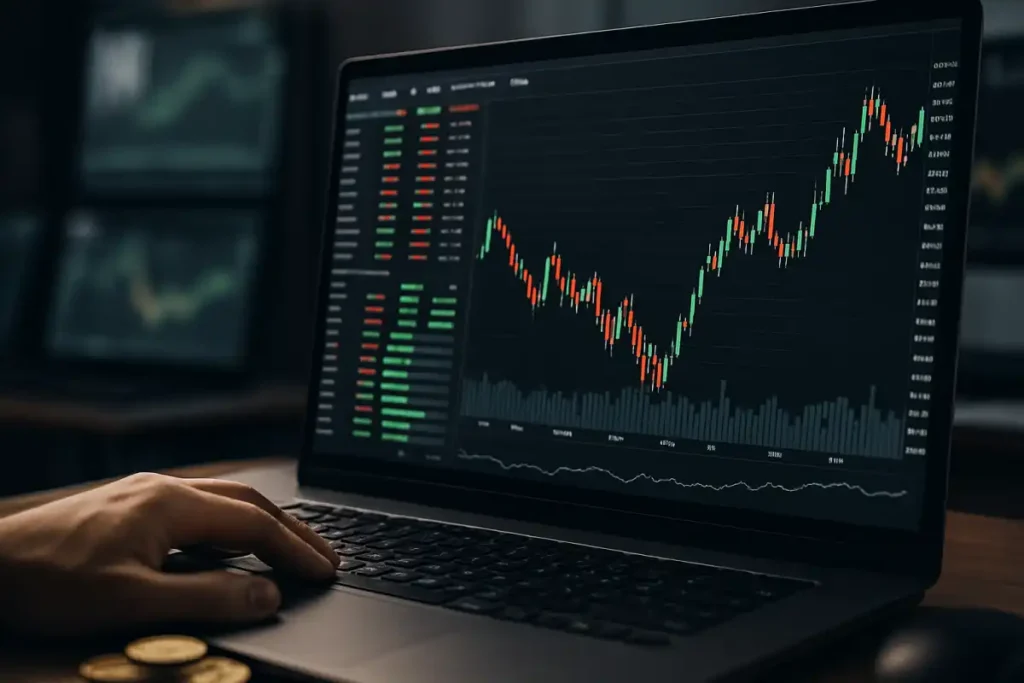
Trading volume refers to the total amount of a financial asset that changes hands during a given period of time. This metric is typically measured over daily, weekly, or monthly intervals and is a key indicator of market activity and investor interest.
How Is Trading Volume Calculated?
Trading volume can be calculated in two main ways:
- By Quantity: How many units of a security or cryptocurrency were traded?
- By Value: What is the total monetary value of these trades?
Example:
If a stock is traded 10,000 times in a day with an average transaction value of $100, the trading volume would be:
10,000 × $100 = $1,000,000
Why Is Trading Volume Important?
Trading volume serves as a valuable signal for investors:





- Measures Liquidity: Higher volume typically means assets can be bought or sold more easily.
- Shows Investor Interest: A rise in volume often reflects increased attention or demand for an asset.
- Confirms Trends: When price movements are accompanied by strong volume, the trend is considered more reliable.
What Does High or Low Trading Volume Indicate?
- High Volume: Suggests active participation in the market and often correlates with higher volatility.
- Low Volume: May indicate market stagnation or investor caution, which can make price movements misleading.
Key Volume Indicators
Several technical indicators are commonly used to analyze trading volume:
- OBV (On-Balance Volume): Connects volume with price movements.
- Volume Oscillator: Compares moving averages of volume over different timeframes.
- Accumulation/Distribution Line: Considers both price direction and volume to determine buying or selling pressure.
These tools help traders identify entry and exit signals.
The Relationship Between Volume and Price
Understanding the volume-price relationship is essential for evaluating market strength:
- Rising Price + Increasing Volume: Indicates a strong uptrend.
- Rising Price + Decreasing Volume: Signals a weakening trend or possible reversal.
- Falling Price + Increasing Volume: Suggests strong selling pressure.
- Falling Price + Decreasing Volume: May point to a bottom or a corrective phase.
Trading Volume in Cryptocurrency Markets
In the world of crypto, trading volume plays a critical role in assessing:
- Exchange reliability and liquidity
- Market sentiment and interest
- Potential manipulative behaviors like “pump and dump” schemes
Platforms like CoinMarketCap and CoinGecko rank cryptocurrencies by trading volume, helping investors gauge market dynamics.
Volume in Stock and Forex Markets
- Stock Markets: Exchanges like Borsa Istanbul (BIST) or NYSE provide daily trading volume data. Volume spikes often reflect heightened interest or news-driven activity.
- Forex Markets: Since forex lacks a centralized exchange, true volume is harder to measure. However, many platforms estimate volume based on liquidity provider data or order flow.
Investment Strategies Based on Volume
Volume analysis supports various trading strategies:
- Breakout Strategy: Traders look for volume confirmation when price breaks key support or resistance levels.
- Trend Following: Sustained high volume often validates trend continuation.
- Reversal Signals: Divergence between price and volume may hint at an impending trend change.
Conclusion
Trading volume is one of the most important metrics in financial analysis, offering insights into liquidity, investor sentiment, and the strength of market moves. While price charts tell part of the story, volume adds context and helps traders avoid false signals.
Whether in crypto, stocks, forex, or commodities, volume analysis should be an integral part of every investor’s toolkit.































Comments are closed.