



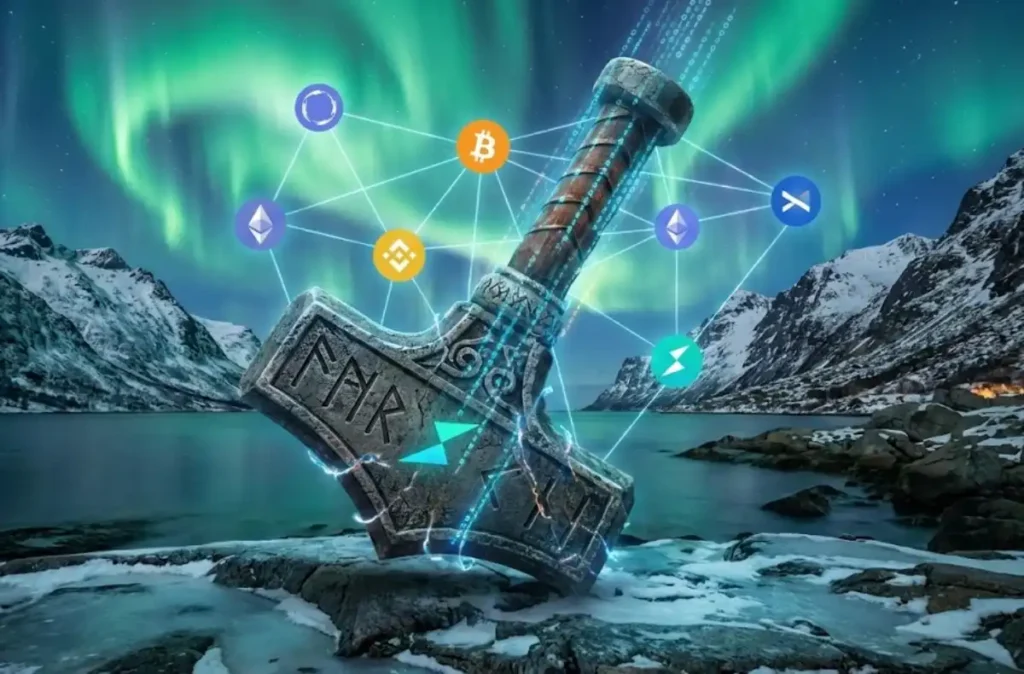

In the world of blockchain, one problem has persisted for years: What do you do when you want to move your assets from the Bitcoin (BTC) network to the Ethereum (ETH) network? Generally, you are presented with two options: You either trust a centralized exchange (like Binance, Coinbase, etc.) with your identity and funds, or you expose yourself to complex bridge risks by using “Wrapped” tokens.
But what if we told you there is a system where you can swap your Bitcoin for Ethereum, or your Litecoin for Dogecoin, without any centralized intermediary, without using synthetic (wrapped) versions, and directly from your own wallet? This is exactly what THORChain (RUNE) does.
In this guide, we will explore the mechanics of THORChain, why the RUNE token is vital, and how this project is revolutionizing the DeFi (Decentralized Finance) ecosystem—written in plain English, free of unnecessary jargon.
Featured News Headlines
What is THORChain? (Simply Explained)
At its simplest, THORChain is a decentralized liquidity protocol that allows you to swap assets between different blockchains without using bridges. It positions itself as a contender for the title of “King of Decentralized Exchanges (DEXs).”





Consider popular DEXs like Uniswap or SushiSwap; they typically operate on a single network (e.g., Ethereum). You cannot sell Bitcoin on Uniswap; you can only sell an Ethereum-based “Wrapped Bitcoin” (wBTC). THORChain is different. It is an independent blockchain built on the Cosmos SDK that connects distinct networks like Bitcoin, Ethereum, BNB Chain, and Avalanche.
Think of it as the digital equivalent of an airport currency exchange kiosk—but decentralized and autonomous. You hand over Dollars and receive Euros; however, there is no teller in the middle, only mathematics and code.
The “Native Swap” Technology That Makes THORChain Special
THORChain’s greatest revolution is the “Native Swap” feature.
- The Traditional Method (Wrapped): You lock your BTC in a bridge, and in return, you are given a “paper representative” (wBTC) valid on the Ethereum network. If that bridge is hacked, the wBTC in your hand becomes a worthless IOU.
- The THORChain Method: You send real BTC to the system, and the system sends you real ETH from the other side. The asset landing in your wallet is the native, original asset of that chain. There are no risky derivatives or proxy tokens.
How Does THORChain Work?
At the heart of the system are Node Operators who secure the network and validate transactions. However, the mechanism here is far more ingenious than a standard exchange.
1. Continuous Liquidity Pools (CLP)
THORChain utilizes the Automated Market Maker (AMM) model seen in Uniswap, but with a critical difference: Every pool must be paired with the RUNE token.
For example:
- Bitcoin Pool: BTC + RUNE
- Ethereum Pool: ETH + RUNE
When you want to give Bitcoin and receive Ethereum, the following process occurs in the background: User sends BTC -> Protocol converts BTC to RUNE -> Protocol converts RUNE to ETH -> User receives ETH.
This transaction happens in seconds, and the user does not see the intermediate RUNE step. This mechanism ensures that the RUNE token is constantly in demand and acts as the cornerstone of the system.
2. The Vault System and Security
THORChain holds assets in “Vaults.” However, these vaults do not have a single owner. The system uses an advanced cryptographic signature method called Threshold Signature Schemes (TSS). For assets to leave a wallet, a supermajority of node operators (e.g., two-thirds) must sign simultaneously. This protects the system against manipulation by any single bad actor.
What is the RUNE Token and What Does It Do?
RUNE is not merely a speculative tool for trading; it is the lifeblood of the THORChain ecosystem. Without RUNE, it is technically impossible for the system to function. Here are RUNE’s four fundamental functions:
- Settlement Asset: As mentioned above, RUNE acts as the bridge currency for swaps between different assets.
- Network Security (Bonding): To become a validator on the network, Node operators must lock (bond) a massive amount of RUNE. If they act maliciously or attempt theft, their locked RUNE is slashed (penalized/confiscated). The value of the locked RUNE must always be higher than the assets in the vault. This relies on the principle that “the cost of theft should always be higher than the profit from the theft.”
- Governance: RUNE holders can have a say in the future of the network, fee structures, or which new chains should be added.
- Incentives: Liquidity providers and node operators are rewarded in RUNE for their contributions.
Advantages and Disadvantages of THORChain
Like any technology, THORChain is not flawless. Here are the pros and cons that investors and users need to know:
Advantages
- No KYC: You can trade completely anonymously without providing identity details.
- Non-Custodial: You maintain control of your assets at all times (except during the brief moment of the swap). Even if the exchange were to close, your money wouldn’t be trapped inside.
- Real Assets: You trade with original coins rather than “Pegged” or “Wrapped” risky assets.
- User-Friendly: Major wallets and interfaces like ShapeShift and Trust Wallet have integrated the THORChain infrastructure.
Disadvantages and Risks
- Software Bugs: In the past, THORChain has suffered exploits and fund losses due to code vulnerabilities (although the project team covered these losses from the treasury, code risk is always present in DeFi).
- Complex Structure: The underlying technology is highly complex, which can slow down the development process.
- Competition: Giants like Uniswap developing “cross-chain” solutions or the proliferation of Layer-2 solutions could increase competition.
The Future of RUNE and Market Sentiment
THORChain is one of the rare projects offering a truly decentralized solution to the “interoperability” problem—crypto’s biggest hurdle. The collapse of centralized exchanges (such as the FTX example) has driven users to keep assets in their own wallets.
For investors, the most attractive aspect of RUNE is its “Deterministic Value” model. As liquidity on the network increases, the amount of RUNE that nodes must lock also increases. Meaning: the more Bitcoin or Ethereum is traded on THORChain, the higher the buying pressure on RUNE becomes. This mathematical relationship directly ties the price of RUNE to the usage of the network.
Why Should You Use THORChain?
If you are a Bitcoin maximalist who still wants to enjoy the benefits of DeFi, or if you want to escape Ethereum’s high gas fees and move your assets to the BNB Chain as real assets, THORChain is currently the most robust route available.
If you dream of a financial future free from the risks of centralized exchanges, uncensorable, and completely transparent, THORChain (RUNE) will continue to be one of the most significant building blocks of that future.



























Comments are closed.