




Featured News Headlines
- 1 What is Star Atlas (ATLAS)?
- 2 The Star Atlas Universe: Three Major Factions in 2620
- 3 Technical Infrastructure and the Cinema-Quality Experience
- 4 Star Atlas’s Dual-Token Economy: ATLAS and POLIS
- 5 Star Atlas Gameplay Dynamics and P2E Mechanics
- 6 The Future and Roadmap of Star Atlas
- 7 Why Star Atlas Matters?
What is Star Atlas (ATLAS)?
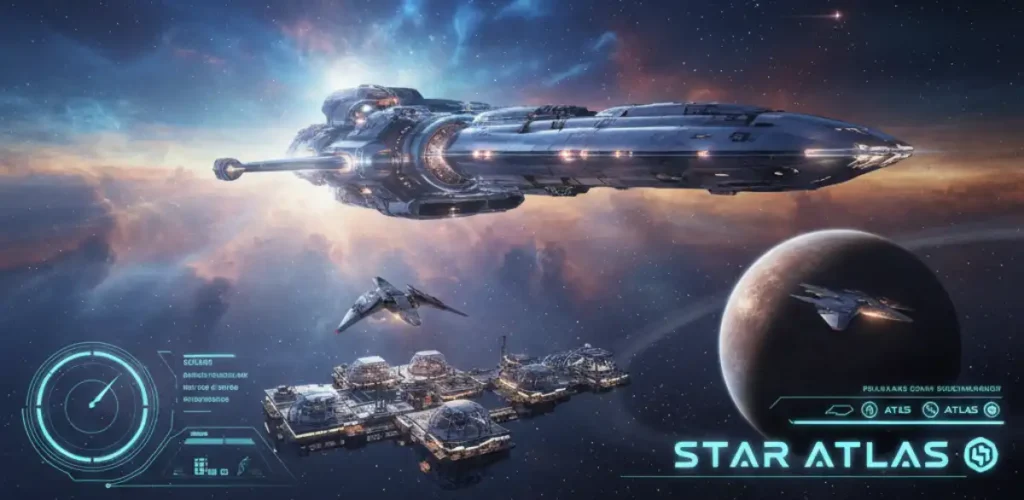
Star Atlas (ATLAS) is a massively multiplayer online metaverse and space exploration game that pushes the boundaries of traditional gaming, powered by blockchain technology and cinema-quality graphics. Set in a science fiction universe in the year 2620, Star Atlas offers players more than just a game; it provides a virtual universe driven by a player-centric economy where users truly own their assets.
This project aims to elevate the “Play-to-Earn (P2E)“ concept to a new dimension by merging the gaming world’s most advanced technologies (specifically Unreal Engine 5’s Nanite technology) with decentralised finance (DeFi) mechanics. At the core of Star Atlas is the principle that every in-game asset—from spaceships and crew members to planetary land and raw materials—is represented as an NFT (Non-Fungible Token) owned by the player.
Key Differences Distinguishing Star Atlas from Traditional Games
In conventional games, in-game assets (swords, armour, skins, etc.) are recorded on a central company’s servers, and the player is merely a “user” of these items. If you quit the game or the company shuts down, those assets lose all value. Star Atlas fundamentally changes this paradigm:
- True Asset Ownership: Every asset in Star Atlas is an NFT. This means ownership of that asset is recorded on the Solana blockchain, and control belongs entirely to the player. No one, not even the Star Atlas developers, can take these assets away from you.
- Player-Driven Economy: The in-game economy is governed entirely by the dynamics of player-to-player trading, crafting, mining, and warfare. Players can freely buy and sell the resources they collect, the ships they manufacture, or the land they conquer for cryptocurrencies with real-world value via the Galactic Marketplace.
- Decentralised Governance: Players have a voice in the game’s future, updates, and the use of treasury funds by voting through the POLIS token. This establishes a DAO (Decentralised Autonomous Organisation) structure, ensuring the game is governed not only by its developers but also by its community.
The Star Atlas Universe: Three Major Factions in 2620
Star Atlas is built upon a breathtaking narrative and deep lore. The year is 2620, and three main Factions are vying for control of the Galaxy:





- MUD (Mankind): The faction controlled by the human race. They represent humans who have achieved great technological advancement and are striving for dominance.
- ONI (Outer Nations Initiative): A consortium formed by a variety of alien species. They aim to secure their existence through peaceful means or by forging alliances.
- Ustur (Ustur Sector): A collective of sentient, synthetic androids created by an advanced AI. They possess a developed sense of culture and identity.
Upon starting the game, players choose one of these three factions, and all subsequent gameplay (exploration, combat, resource gathering) revolves around this factional allegiance. The conflict and cooperation between these factions form the bedrock of the Star Atlas universe’s political and economic dynamics.
Technical Infrastructure and the Cinema-Quality Experience
A critical feature that sets Star Atlas apart from other P2E games is its focus on technical infrastructure and graphic fidelity.
Unreal Engine 5 and Nanite Technology
The core gameplay experience is being developed using one of the industry’s most cutting-edge game engines, Unreal Engine 5 (UE5). Thanks, in particular, to UE5’s Nanite virtualised geometry technology, Star Atlas aims to deliver cinema-quality and incredibly detailed real-time environments. This means players will experience not just a “crypto game,” but an AAA-quality space simulation and exploration RPG.
The Solana Blockchain and High Throughput
Star Atlas utilises the Solana (SOL) blockchain to manage its entire in-game economy and asset ownership. Solana was chosen primarily for its high transaction throughput (tens of thousands of transactions per second) and low transaction fees.
High “Gas” fees and slow transaction times on traditional blockchains pose a major obstacle to running an MMORPG economy. Solana, however, allows even micro-interactions (e.g., refuelling a ship, gathering a piece of resource) to be executed on-chain instantly and at a low cost, enabling a seamless and real-time gameplay experience.
Star Atlas’s Dual-Token Economy: ATLAS and POLIS
At the heart of the Star Atlas ecosystem lies a dual-token system with two distinct, complementary functions:
1. The ATLAS Token (Utility Token)
The ATLAS token is the primary medium of exchange and utility token of the Star Atlas metaverse. It functions like the “gold” or “currency” in a traditional game but carries real-world value.
- Uses:
- In-Game Purchases: Buying new spaceships, crew members, gear, weapons, and consumables (fuel, repair kits).
- Crafting and Production: Paying the necessary fees to refine raw materials and manufacture new equipment or ships.
- Rewards: It is the primary reward players earn when completing in-game missions, mining resources, or executing successful trades.
- Marketplace Currency: It is the fundamental cryptocurrency used for buying and selling NFT assets on the Galactic Marketplace.
ATLAS is structured to be inflationary to meet the growing demand as the game economy expands. However, this supply is intended to be balanced by in-game economic activity and token burning mechanisms.
2. The POLIS Token (Governance Token)
The POLIS token is the governance token of the Star Atlas universe, granting players political power.
- Uses:
- Governance and Voting: POLIS holders have the right to vote through the Star Atlas DAO (Decentralised Autonomous Organisation) on the game’s future, economic policies, token supply changes, development direction, and major decisions.
- Passive Income: Players who lock their POLIS tokens (Staking) to contribute to the governance process can earn rewards.
- In-Game Political Influence: Future updates are expected to give POLIS a more direct political effect in inter-faction conflicts, the determination of regional taxes, or major corporate decisions.
POLIS has a limited supply and is strategically important as it ensures the decentralised control of the Star Atlas project.
Star Atlas Gameplay Dynamics and P2E Mechanics
Star Atlas offers rich gameplay depth by combining elements from several different game genres. The core gameplay pillars are:
1. Exploration and Mining
Players journey into the depths of the Galaxy, scanning uncharted star systems and planets. During this exploration, they discover valuable NFT-based resources and artifacts.
- Resource Gathering: Raw materials (ores, gases) are extracted using spaceships or mining rigs established on land. These raw materials form the basis of trade and manufacturing.
- Risk and Reward: Deep space regions outside the “Security Zone” contain rarer and more valuable resources, but the risk of losing a ship or engaging in combat with other factions is significantly higher.
2. Trading and Crafting
The economy of Star Atlas is entirely player-driven.
- Production Chains: Raw materials are refined and turned into finished products (spaceship components, fuel, ammunition, armour). Players can earn ATLAS by taking on different roles in the production and supply chains (miner, refinery operator, manufacturer, cargo hauler).
- Galactic Marketplace: All NFT assets and manufactured materials are bought and sold through the Galactic Marketplace, a fully decentralised NFT exchange.
3. Combat and Territorial Conquest
Star Atlas encompasses both large-scale fleet battles and first-person shooter (FPS) / ship simulation combat.
- Space Warfare: Players can manage their own fleets or unite (forming DACs – Decentralised Autonomous Corporations) to attack territories belonging to other factions.
- Claim Staking: When battles are won, players or DACs can stake a claim over new territories and collect a portion of the resources generated there as tax revenue.
- Ship Permadeath: One of the most compelling and risky mechanics of the game is the potential for ships to be permanently destroyed in dangerous areas. This adds genuine excitement to risky operations and necessitates a cautious approach to NFT assets.
4. Decentralised Autonomous Corporations (DACs)
Players can form in-game corporations known as DACs. A DAC functions like a real-world company: it can issue shares/tokens, establish a board of directors, and collectively finance large operations (colonising a planet, setting up a giant trade fleet). DACs are one of the main conduits of political and economic life in Star Atlas.
The Future and Roadmap of Star Atlas
Star Atlas is an ambitious project with a very long-term, phased development process. While the release of the final, cinematic-quality UE5 game (First Person Shooter / Ship Simulation) will take time, the team is continuously activating various gameplay experiences:
- SAGE (Star Atlas Golden Era): This is a browser-based, 4X (eXplore, eXpand, eXploit, eXterminate) strategy game. It allows players to manage their fleets, mine resources, and establish trade routes, effectively activating the core economy of the main game already.
- Galactic Marketplace: The active marketplace for trading NFT assets and tokens.
- Holosim / Mini Games: Early access and simplified gameplay experiences that allow players to use their Star Atlas assets and earn ATLAS.
The long-term vision of the project is for the final UE5-based game to seamlessly integrate all these mechanics and assets into one cohesive, cinematic metaverse experience.
Why Star Atlas Matters?
Star Atlas (ATLAS) is more than just a “crypto game”; it is a vision with the potential to shape the future of Web3 and the metaverse. The project aims to prove that digital assets and in-game economies can possess real-world value and ownership by combining cutting-edge gaming technology (Unreal Engine 5), high-performance blockchain infrastructure (Solana), and decentralised finance (DeFi) mechanics.
It offers players the freedom to become a space explorer, trader, pirate, or emperor while also granting them the power to vote on the game’s future (POLIS) and the opportunity to earn real income from their economic activities (ATLAS).
While Star Atlas faces challenges, such as a long development timeline and high expectations inherent to an ambitious project, if it successfully executes its vision, it will attract the attention of the traditional gaming industry and redefine the standard for blockchain-based games—becoming a truly revolutionary metaverse.
The ATLAS token, as the primary currency circulating through the commercial veins of this vast and dynamic universe, is directly tied to the success of the Star Atlas ecosystem. This makes it the key and the fuel for this new digital civilization in the depths of space.



























Comments are closed.