



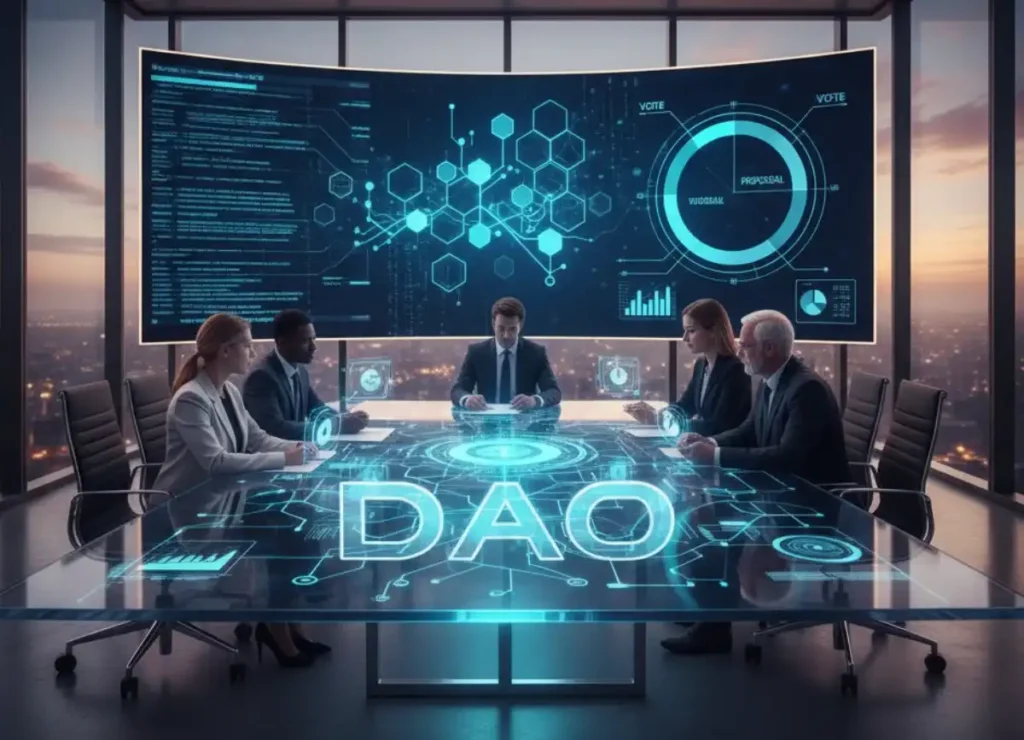

In recent years, with the rise of blockchain technology, a revolutionary concept has emerged, pushing the boundaries of traditional corporate structures: Decentralized Autonomous Organizations (DAOs). More than just a trend, DAOs present a powerful vision for the future of business, finance, and community governance. But what exactly is this seemingly complex structure, and how does it fundamentally differ from traditional companies?
Featured News Headlines
What is a DAO? Core Concepts and Definition
A Decentralized Autonomous Organization (DAO) is essentially a digital entity collectively governed by its members, requiring no central authority—such as a CEO, board of directors, or a hierarchical management structure. These organizations execute all their rules and operational mechanisms transparently through smart contracts that are coded onto a blockchain.
Three key terms encapsulate the essence of this structure:
- Decentralized: The authority to make decisions and the control are distributed among all the organisation’s members, rather than being concentrated in a single central point. There is no single point of failure or arbitrary decisions by a sole authority.
- Autonomous: Since the rules are coded into smart contracts, the organisation operates automatically, requiring minimal human intervention. Once decisions are reached, the contracts execute the implementation independently.
- Organization: It is a structure possessing a treasury (funds) and a community that has come together to achieve specific common goals.
In summary: DAOs are internet-native, collectively owned entities or communities that eliminate management hierarchy, encode their rules in code, and make decisions through transparent, on-chain voting.


How Do DAOs Work? Mechanism and Governance
The operation of a DAO is primarily driven by its members who hold the organisation’s native governance token (cryptocurrency). The process generally follows these steps:
- Rule Set and Smart Contracts: The rules, which function as the DAO’s constitution, are immutably coded onto the blockchain. Everything, from how funds are to be spent, to how new members are admitted, and the voting mechanism itself, is defined within this code.
- Governance Token: Members become part of the organisation by possessing its native token. The rule is typically “One token, one vote,” though some DAOs may employ different systems (e.g., voting power based on the duration of membership).
- Proposal Process: When a member wishes to suggest a change, a fund allocation, or a new strategy for the organisation, they submit a “proposal.” These proposals are often limited to members who hold a certain token threshold.
- Voting: The proposal is put up for a vote by the token holders. Once the voting period concludes, smart contracts automatically enforce the decision based on the predetermined majority rule (e.g., 51% or 66% of the votes).
- Implementation: The decision passed by the vote is carried out automatically by the smart contracts, without human interference.
This process ensures that the organisation is completely transparent, as all transactions and votes are recorded on the blockchain, publicly verifiable by anyone.
Key Differences from Traditional Organisations
DAOs diverge radically from conventional corporate models (such as limited companies):
| Feature | Traditional Organisation | Decentralized Autonomous Organisation (DAO) |
| Management | Centralised (CEO, Board of Directors) | Decentralized (Token Holders’ Voting) |
| Rules | Legal documents, internal regulations | Smart Contracts Coded on the Blockchain |
| Transparency | Financial and operational data is limited | All operations (voting, funds) are public |
| Participation | Limited to shareholders and employees | Anyone holding the token can participate |
| Operation | Bureaucratic processes and human decisions | Automated and code-bound (Autonomous) |
Advantages and Potential of DAOs
The DAO structure offers a number of significant advantages over traditional models:
- High Transparency: Since all decisions, votes, and fund movements are recorded on the blockchain, the risk of fraud or corruption is minimised. Trust is placed in the code, not in institutions.
- Democratic Governance: It prevents a single person or a small group from monopolising power. The right to influence the organisation’s future is fairly distributed among token holders.
- Global Access and Inclusivity: Anyone with internet access, anywhere in the world, can become a part of a DAO by acquiring its token and participate in its governance.
- Censorship Resistance: Due to the lack of a central governing body, DAOs are more resilient to external pressures or attempts at censorship.
- Fast and Efficient Operation: Thanks to smart contracts, the implementation of voting outcomes is quick and automated, effectively eliminating bureaucracy.
Challenges and Risks
Like any innovation, DAOs face challenges that are yet to be fully ironed out:
- Regulatory Uncertainty: The legal status of DAOs is unclear in many jurisdictions. Whether they constitute a legal entity, how they are taxed, and the liability of their members are still grey areas.
- Security Risks: Errors (bugs) in the smart contract code can lead to the compromise of funds or the organisation’s operation. The hack of the first major DAO project, “The DAO,” serves as a painful historical example of this risk.
- Participation Issues: While every token holder is expected to vote, sometimes voter turnout can be low due to a “silent majority,” leading to the risk of governance being captured by a minority (the “whale problem”).
- Coordination Difficulty: Achieving consensus among a large number of geographically dispersed members can be time-consuming and challenging.
Use Cases and Examples of DAOs
DAOs are being utilised across a multitude of sectors, from financial services to art collecting:
- DeFi Protocols (Decentralized Finance): The governance of major DeFi platforms like Uniswap, Aave, and MakerDAO is conducted by the community that uses the protocol and holds its token.
- Grant DAOs: Organisations that distribute funds to support the development of a specific ecosystem (e.g., grants for protocol improvements).
- Collector DAOs: Groups formed to collectively purchase and manage valuable NFTs or physical artwork. ConstitutionDAO is one of the most famous examples, established to bid on a rare copy of the US Constitution.
- Social DAOs: Communities that gather around a specific purpose or interest and manage member interactions.
The Organisation Structure of the Future
Decentralized Autonomous Organizations (DAOs) are not just a technological step forward; they herald a more transparent and democratic future where trust is placed in code, and power is devolved to the community. Although still in their infancy, their potential to transform traditional corporate governance, politics, art, and finance is undeniable.
DAOs are redefining the structure of collective decision-making and organisation for the 21st century by leveraging the tools of decentralisation, transparency, and automation offered by the digital age. To become a part of this revolution, the most crucial steps are to research the governance tokens of relevant DAOs and actively participate in their communities.





















Comments are closed.