




Featured News Headlines
- 1 What is Akash Network (AKT)?
- 2 Akash Network (AKT) Fundamentals: The Decentralized Supercloud
- 3 How Does Akash Network Work? The Architectural Cornerstones
- 4 Why Akash Network? The Advantages of Decentralization
- 5 Akash and the Age of Artificial Intelligence (AI)
- 6 Akash Network’s Technical Depth and Roadmap
- 7 Is the Future of Cloud Computing Decentralized?
What is Akash Network (AKT)?
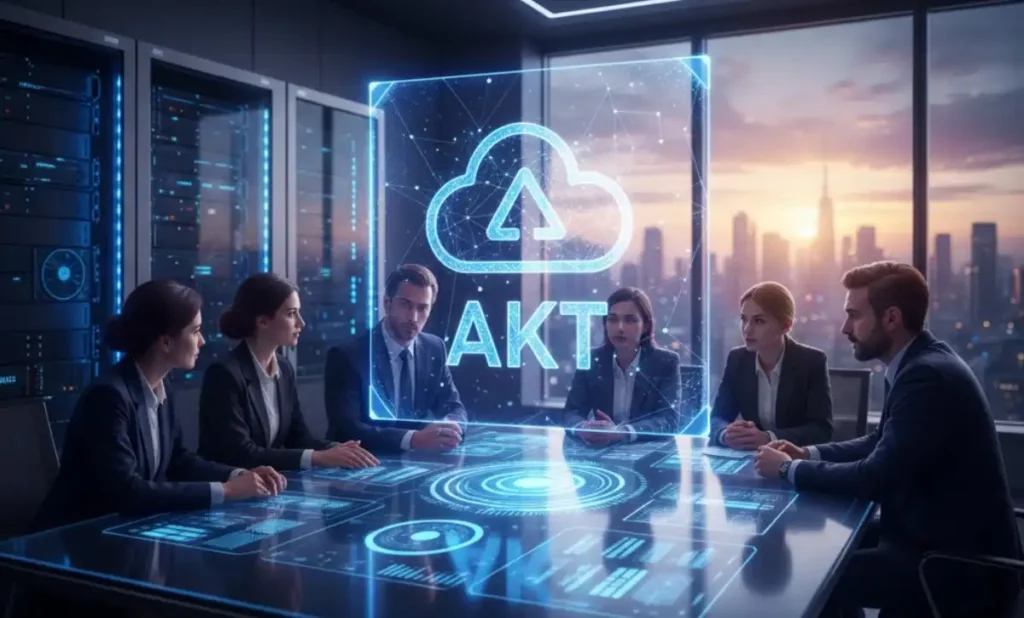
The traditional realm of cloud computing is characterized by a centralized structure, largely controlled by a few giants: Amazon Web Services (AWS), Google Cloud, and Microsoft Azure. This centralization brings with it high costs, limited flexibility, and the inherent risks of a potential monopoly. However, with the rise of blockchain technology, a revolutionary new approach has entered the space: Akash Network (AKT).
Akash Network is an open-source protocol aiming to fundamentally transform this enormous industry by offering a powerful, cost-effective, and, crucially, a decentralized alternative to existing cloud computing services. But what exactly is Akash Network, how does it function, and why does it hold such significant importance for the future of the technology world?
Akash Network (AKT) Fundamentals: The Decentralized Supercloud
At its core, Akash Network (AKT) is a distributed, permissionless cloud computing platform built using the Tendermint blockchain technology and the Cosmos SDK. The project’s main philosophy is to pool together globally idle computing resources and deliver them to users who require those resources via a secure and transparent marketplace.
Akash’s self-designation as a “Supercloud” is well-earned. The network provides all the functionality offered by traditional cloud providers (AWS, Google Cloud, etc.) but at significantly lower costs and on a decentralized architecture. This sits at the very heart of its mission to democratize access to cloud services for developers, enterprises, and individuals alike.





The AKT Token: The Vital Fuel of the Network
The platform’s native cryptocurrency is the AKT (Akash Token). AKT is the lifeblood of the Akash Network ecosystem and fulfills several critical roles required for the network’s smooth operation:
- Medium of Exchange: Tenants (users needing cloud resources) make payments for services using AKT tokens. This is the foundational economic cycle that anchors value within the network.
- Staking and Security: AKT holders can stake (lock up) their tokens to delegate power to validators who secure the network, or they can serve as validators themselves. Staking reinforces the network’s Proof-of-Stake consensus mechanism and rewards participants.
- Governance: AKT holders actively participate in the decision-making processes regarding the protocol’s future and critical updates (governance rights). This ensures that Akash Network remains a community-driven, decentralized project.
How Does Akash Network Work? The Architectural Cornerstones
Akash’s innovative architecture is structured around two key components: the Akash Compute Marketplace and the Akash Container Platform. These two elements transparently connect supply and demand on the blockchain.
The Akash Compute Marketplace
This is the heart of Akash, utilizing the world’s first reverse auction model for cloud services.
- Providers: Anyone with idle server or computing capacity (from data centers to individuals) can list these resources on the Akash network as a “provider.” Providers register the specifications of their resources (CPU, GPU, RAM, storage) and their minimum required price on the blockchain.
- Tenants: These are the users who require computing power to run their applications or train AI models. Tenants publish a Deployment Manifest detailing the resources they need.
- Reverse Auction: When a tenant’s request is posted on the network, potential providers respond by submitting their price bids. Unlike a traditional auction, in Akash, the bid offering the lowest price and best meeting the tenant’s requirements wins. This competitive environment allows users to realize cost savings of up to 80% compared to traditional cloud services.
The Akash Container Platform
Once the winning provider is determined, the application deployment phase begins. Akash leverages containerization technology, the modern standard in software development.
- Containerization: Akash supports Docker, the popular container format, for deploying applications. Containers bundle all the necessary code, libraries, and dependencies required to run an application into a single, portable package.
- Management with Kubernetes: Akash utilizes the industry-standard Kubernetes (K8s) technology to automate the deployment, scaling, and management of these containers. This means developers can deploy and manage their applications just as easily as they would on AWS or Google Cloud, but on a decentralized infrastructure.
These two components provide the technical depth that establishes Akash not just as a crypto project, but as a serious competitor to the existing Web 2.0 infrastructure.
Why Akash Network? The Advantages of Decentralization
The model offered by Akash Network delivers a series of significant benefits over centralized cloud services.
Exceptional Cost Efficiency
While the fixed costs of centralized cloud giants (data centres, massive operational expenses) are baked into their prices, Akash can offer much more affordable rates because it essentially rents out underutilized capacity. The reverse auction mechanism incentivizes providers to offer the best price, which naturally drives down costs for tenants. Research has consistently shown that costs on Akash are dramatically lower for the same workload compared to its centralized competitors.
Censorship Resistance and Data Sovereignty
Akash is not controlled by a single central authority. Applications and data are hosted on a network of geographically distributed, independent providers. This means applications or users cannot be arbitrarily censored or taken offline. Users maintain complete sovereignty over their data and applications.
High Accessibility and Flexibility
In theory, Akash Network can turn any data centre, server, or even an individual computer worldwide into a potential cloud resource. This vast, global pool of resources eliminates the geographical constraints of traditional cloud regions. Developers can access the resources they need much faster and more easily.
Open Source and Community Governance
Akash is an entirely open-source protocol. This transparency means anyone can audit the code and contribute to its development. The community-centric governance model (via AKT holders) ensures that the project’s future rests in the hands of its users, not a single corporation.
Akash and the Age of Artificial Intelligence (AI)
The recent explosion in Artificial Intelligence (AI) and Machine Learning (ML) has driven GPU (Graphics Processing Unit) demand to stratospheric levels. The high-performance GPUs required to train and run AI models have become both prohibitively expensive and difficult to access on traditional cloud services.
Akash Network is rapidly emerging as the solution to this problem.
- GPU Integration: Akash has been focused on integrating high-end GPUs from manufacturers like NVIDIA (such as the Blackwell series) into its network. This grants AI developers access to the very same hardware that is rented at exorbitant prices on centralized clouds, but much more affordably and quickly on Akash.
- Cost Leadership: AI/ML workloads are very compute-intensive, leading to high hourly costs. Akash’s cost advantage makes a massive difference for AI researchers and startups. Lowering the cost of model training accelerates innovation.
- Pioneering DePIN: Akash is one of the most significant representatives of the Decentralized Physical Infrastructure Networks (DePIN) movement. DePIN projects use the blockchain to decentralize real-world infrastructure services (cloud computing, wireless networks, energy). Akash is a pioneer of this revolution in cloud computing.
Akash Network’s Technical Depth and Roadmap
Akash is built on the Cosmos ecosystem. This grants it the high scalability offered by Cosmos and the ability to seamlessly interact with other blockchains via the Inter-Blockchain Communication (IBC) protocol. This interoperability makes Akash not just a cloud platform, but an integral part of the broader decentralized web (Web3) ecosystem.
AKT 2.0 and Future Developments
Akash is a continually evolving project. The updates that have been implemented or are planned aim to increase the network’s sustainability and competitive edge:
- Take Fees (Revenue Sharing): A portion of the fees generated from transactions on the network is distributed to staked AKT holders. This incentivizes token holding and enhances network security.
- Public Goods Fund: Funds set aside to support the network’s growth and developers.
- Persistent Storage and Dedicated IPs: The integration of persistent storage solutions and options for renting fixed IP addresses, which are critical for enterprise-level applications.
Is the Future of Cloud Computing Decentralized?
Akash Network (AKT) offers not just an alternative to the traditional cloud computing model, but a superior one. It is creating a cost-effective, flexible, censorship-resistant, and high-performance pool of computing resources for developers, startups, and large enterprises.
Considering that cloud computing is a multi-trillion-dollar industry, Akash’s marketplace model has the potential to capture a significant share of this massive market. Especially with the proliferation of GPU-intensive workloads like Artificial Intelligence (AI) and Machine Learning (ML), Akash’s advantages in cost and accessibility position it as a strong candidate to become one of the foundational building blocks of the digital infrastructure of the future.
By combining decentralization, transparency, and the power of the community, Akash Network proves that cloud computing can be managed not only efficiently but also fairly and democratically. To understand AKT is to understand not just a cryptocurrency, but one of the fundamental infrastructure layers of Web3.




























Comments are closed.