





Bitcoin’s Quantum Challenge: Are Segwit Addresses Safe Enough?
Bitcoin Faces Quantum Computing Threat – The urgency to make Bitcoin resistant to quantum computing attacks is gaining attention across the crypto industry. While networks like Solana have deployed post-quantum signatures on their testnet and Ethereum has a roadmap for quantum security, Bitcoin’s path remains a topic of heated debate.
Saylor’s Unconventional Take on Quantum Threats
Despite mounting concerns, Michael Saylor, the architect of corporate BTC treasury strategies, has expressed a markedly different view. He recently stated that quantum computing will “harden BTC,” not break it. According to Saylor, major tech firms will manage the threat, and quantum technology will not go mainstream until governments update their systems.
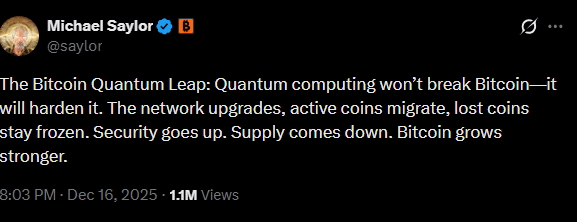
However, Saylor’s nonchalance has drawn criticism from many experts. Eli Ben-Sasson, founder of Starknet and Zcash, argued that while Saylor’s plan may work in theory, it is impractical in reality due to consensus challenges. He noted that code is highly ossified, making upgrades difficult. Similarly, Mihailo Bjelic, former co-founder of Polygon, emphasized that a full Bitcoin upgrade could take around two years, or six months if transactions pause—a scenario he calls unrealistic.
Assessing the Quantum Risk
Despite Google’s quantum computing breakthroughs, the technology is still 5-15 years away from threatening Bitcoin’s network or wallets. Nonetheless, Charles Edwards, founder of Capriole Investments, estimates a 34%-55% chance that BTC could be compromised by quantum computers by 2028-2030 if upgrades are not implemented. He warns that Bitcoin’s value could be impacted proportionally.





Bitcoin’s security depends on ECDSA (Elliptic Curve Digital Signature Algorithm) and SHA-256 hashing. While old-format addresses, especially from the Satoshi era, are increasingly vulnerable, newer Segwit addresses offer partial protection against long-range quantum attacks.



























Comments are closed.