





Featured News Headlines
Fed Chair Powell Honors Shultz While Skipping Economic Forecasts
Federal Reserve Chair Jerome Powell delivered a carefully framed speech that avoided any direct commentary on current economic conditions, despite intense anticipation from market observers. With the next Federal Open Market Committee (FOMC) meeting only days away and expectations rising over potential rate cuts, Powell’s appearance drew heightened scrutiny.
Speech Timing Raises Speculation
The event took place as political speculation accelerates around President-elect Trump’s upcoming selection of the next Fed chair. Powell’s term ends in May 2026, and former Council of Economic Advisers Chair Kevin Hassett is reportedly among the top contenders.
Still, Powell opened with a clear boundary:
“I will not address current economic conditions or monetary policy,” he said, choosing instead to commemorate the legacy of the late statesman and economist George Shultz.
Even so, Powell’s reflections on the history of inflation policy carried implicit relevance. He invoked the wage-and-price-control era of the Nixon administration and stressed the constant evolution of macroeconomic understanding:





“Our understanding of the economy is ever evolving… certain things that are sometimes accepted as conventional wisdom, people will look back in 50 years and think, what were they thinking?”
For analysts, these remarks served a dual purpose: an acknowledgment that the Fed’s judgment is never infallible, and a subtle defense of its policy approach amid ongoing criticism.
His comments came as the Fed has effectively concluded its quantitative tightening cycle, halting reductions in liquidity—an outcome that could help stabilize financial conditions for banks, funds, and risk-exposed institutions.
Powell Declares Fed’s Role in Price Stability “Settled”
Powell’s strongest message centered on the Fed’s mandate:
“We understand now that the central bank is responsible for price stability. That issue is settled. It doesn’t mean it’s easy to do, but the issue is settled.”
His reaffirmation arrives at a politically sensitive moment. Members of the incoming administration have signaled interest in reshaping the central bank’s leadership and approach. Hassett recently commented, “Monetary policy has gotten very complicated… I think we’ve got to simplify things.”
Powell’s remarks highlighted the importance of central bank independence—long a cornerstone of the institution’s credibility. By underscoring responsibility and data-driven decision-making, Powell reinforced continuity at a time when the Fed’s future leadership is under debate.
Honoring George Shultz: Principles, Integrity and Market Wisdom
Throughout the event, Powell emphasized Shultz’s policy philosophy, praising his blend of integrity and pragmatism.
He noted that Shultz combined “strong principles and unshakable integrity with practical problem solving.”
Powell also highlighted Shultz’s confidence in market-driven outcomes:
“He had a deep belief in the wisdom of markets.”
Observers noted that Powell’s tribute may reflect his own guiding principles as he prepares for the final stretch of his term.
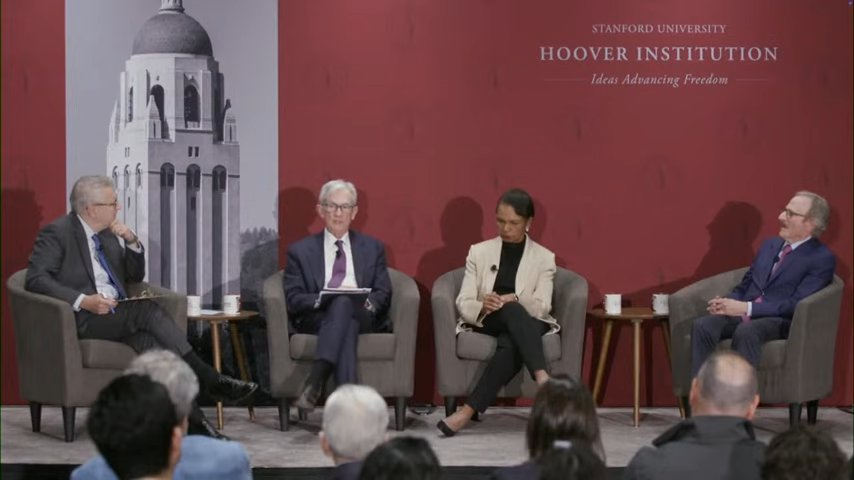
Hosted by the Hoover Institution at Stanford, the ceremony featured moderator Peter Robinson, former Secretary of State Condoleezza Rice, and economist Michael Boskin, all paying homage to Shultz’s five-decade impact on economic policy.



























Comments are closed.