




Featured News Headlines
What is Front Running?
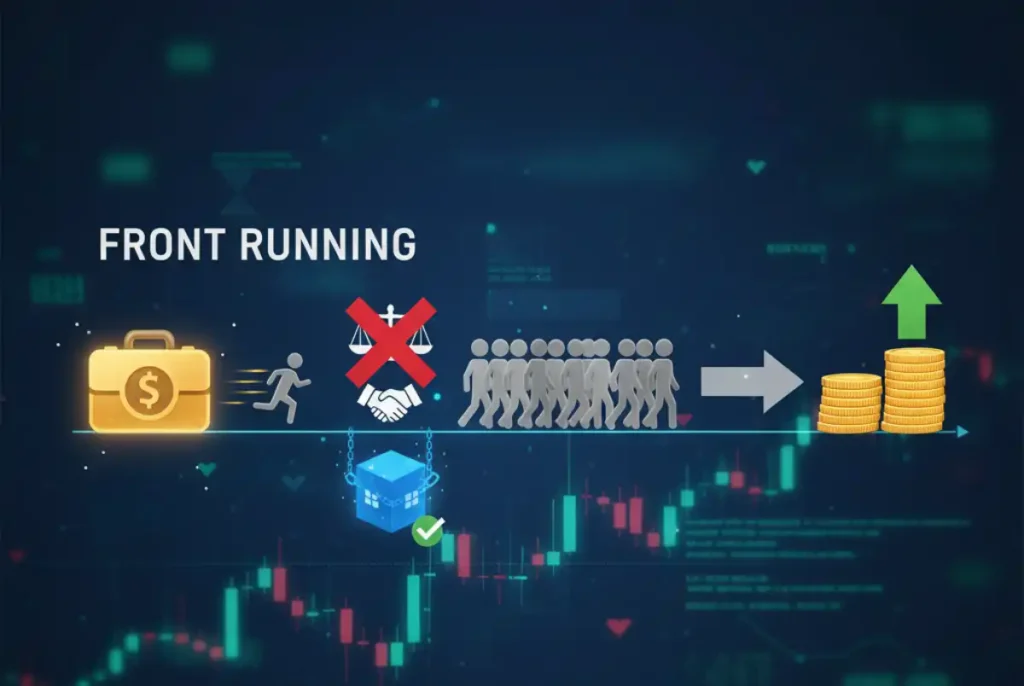
In the intricate world of finance, Front Running is the unethical and often illegal practice of a broker or an individual using insider knowledge of a pending, large-scale transaction to their own advantage. It’s an act that bears a striking resemblance to insider trading, yet it often encompasses a broader range of market manipulations. In simple terms, when someone learns that a significant buy or sell order is about to hit the market, they can anticipate the resulting price movement. They then place their own order just ahead of the large one, and once the price shifts, they profit from the change.
The term Front Running is most frequently encountered in the volatile cryptocurrency markets, within decentralized finance (DeFi), and in traditional stock markets. In the crypto world, this practice is largely automated by bots and smart contracts, while in traditional markets, it’s typically an illegal activity driven by human actors.
How Does It Work?
Front Running in Traditional Markets
Consider an employee at a brokerage firm. This individual learns that a major investment fund is about to purchase a massive block of shares in a particular company. Armed with this non-public information, which indicates an imminent price increase, the employee buys the same stock for their personal account just before the fund’s order is placed. When the fund’s large order is executed, the stock’s price surges, and the employee can then sell their shares at a higher price, pocketing a tidy profit. This action is strictly illegal and carries severe legal penalties.
Front Running in Crypto Markets
In the crypto sphere, Front Running operates differently and is far more technical. On public blockchains like Ethereum, pending transactions are visible to everyone. To have a transaction processed, users pay a gas fee. The higher the fee, the faster a miner will include your transaction in a block.





The logic behind crypto Front Running is straightforward:
- A bot scans the blockchain’s transaction pool, or “mempool,” and detects a large pending transaction for a specific asset.
- The bot quickly prepares its own buy order for the same asset.
- To ensure its transaction is processed first, the bot pays a significantly higher gas fee than the original transaction. This gives it “priority” in the block.
- Once the large, target transaction is confirmed, a major liquidity movement occurs, causing the asset’s price to jump.
- The bot immediately sells the asset it just acquired at the inflated price, securing a profit.
This entire process is automated and unfolds in a matter of seconds, making it particularly prevalent in situations like a new token launch, where prices can skyrocket in an instant, allowing a small group to capitalize on the surge.
Why Is Front Running a Problem?
- It Undermines Market Integrity: Front running erodes trust and disrupts the fair and transparent environment that markets need to function properly.
- It Harms Small Investors: The automated competition for transaction priority often forces smaller investors to pay higher transaction fees. Furthermore, the resulting price volatility can lead to significant losses for those who are simply trying to trade.
- It Can Lead to Scams: In some cases, front running is exploited by malicious actors to manipulate token prices and execute pump-and-dump schemes.
- It Contradicts Decentralization: At its core, the philosophy of blockchain is built on transparency and equitable access. Front running directly conflicts with these foundational principles.
How Can You Protect Yourself from Front Running?
- Utilize Private Transactions: Some crypto wallets offer a service that prevents your transaction from being sent to the public mempool. This keeps your order hidden from potential front-running bots.
- Split Large Orders: If you’re planning a substantial transaction, breaking it into several smaller parts can make it less noticeable to bots that are programmed to target large orders.
- Adjust Your Slippage Tolerance: Slippage tolerance defines the maximum price difference you’re willing to accept for your transaction to go through. While a low tolerance can cause your transaction to fail, a high one can leave you more vulnerable to front running.
Conclusion
Front Running is an unethical and, in many cases, illegal practice that plagues both traditional finance and the crypto world. While regulatory bodies keep a tight leash on it in traditional markets, the decentralized nature of crypto makes this oversight far more challenging. Therefore, it is crucial for crypto users to be aware of this risk and take proactive measures to protect their assets and ensure fair transactions.






























Comments are closed.