


Featured News Headlines
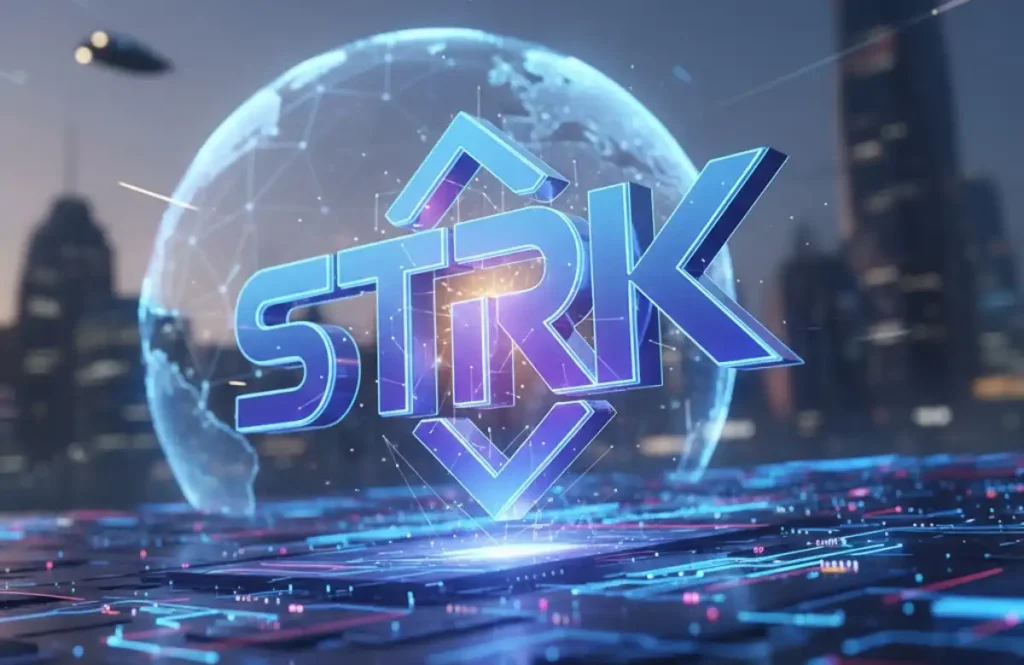
What is Starknet (STRK)?
With the rise of cryptocurrencies and blockchain technologies, Ethereum, the most popular home for decentralized applications (dApps), has faced significant challenges, including scalability issues, slow transaction speeds, and high transaction costs (Gas Fees). These issues represent the difficulty—known as the “Blockchain Trilemma”—of simultaneously achieving security, decentralization, and scalability. It is precisely at this juncture that Layer-2 (L2) solutions come into play, aiming to resolve Ethereum’s scalability problem without compromising its core security and decentralization structure.
In this comprehensive guide, we will delve into one of the most innovative and high-potential L2 solutions: the Starknet (STRK) project.
What is Starknet (STRK)? Core Definition and Positioning
Starknet is a decentralized Layer-2 (L2) scaling protocol built on top of Ethereum, utilizing a Validity Rollup (ZK-Rollup) architecture.
In simple terms, it can be defined as:





- A Layer-2 Solution: Designed to alleviate the load on the Ethereum mainnet (Layer-1) by executing the vast majority of transactions off-chain.
- Validity Rollup (ZK-Rollup): It aggregates thousands of transactions, processes them off-chain, and then submits a single cryptographic proof to the Ethereum mainnet, attesting to the validity of these transactions. This mechanism significantly increases speed and throughput without sacrificing security.
- STARK Proofs: The cryptographic technology underpinning Starknet is STARK (Scalable Transparent ARguments of Knowledge) proofs—a form of Zero-Knowledge Proof.
The creator of Starknet is StarkWare Industries, a major player in the blockchain and cryptography space, founded in 2018 by Eli Ben-Sasson, Uri Kolodny, Michael Riabzev, and Alessandro Chiesa.
The Unique Technology That Sets Starknet Apart: STARK Proofs
The most critical feature distinguishing Starknet from other L2 solutions is its use of STARK (zk-STARK) proofs.
In traditional blockchains, verifying a transaction requires every node to re-execute the transaction from start to finish. Starknet, conversely, takes thousands of transactions, bundles them into a single block, and generates a single, tiny cryptographic proof that proves the correctness of these aggregated transactions.
So, what makes STARK so revolutionary?
- Transparency: Unlike some other ZK-Proof systems, STARKs do not require a “trusted setup.” This means the protocol is inherently more transparent and reliable.
- Scalability: The size of the proof grows only logarithmically with the number of transactions bundled off-chain. This allows it to efficiently prove hundreds of thousands of transactions—hence the “Scalable” (Ölçeklenebilir) component in the name Starknet.
- Quantum Resistance: STARK proofs have been designed to be more resistant to potential threats posed by future quantum computers.
How Does Starknet Work? A Deep Dive into the Architecture
Starknet’s operating principle relies on the simultaneous work of three core components:
1. Sequencers
- Role: They receive, order, and bundle all user transactions off-chain, similar to miners in Ethereum.
- Process: They execute the transactions, calculate state updates, and generate an execution trace of the batch.
2. Provers (Stark Verifiers)
- Role: They take the aggregated transaction execution trace from the Sequencers and generate the STARK proof that attests to the correct execution of these transactions.
- Key Insight: The size of this proof is minimal, regardless of the number of transactions aggregated. This significantly reduces the data that must be sent back to Ethereum.
3. The Verifier Smart Contract on Ethereum
- Role: This contract resides on the Ethereum mainnet and receives the STARK proof from the Prover.
- Verification: It cryptographically checks whether the proof is mathematically valid. If the proof is sound, the contract records the new state of the aggregated transactions onto the Ethereum blockchain.
- Outcome: Ethereum effectively validates thousands of transactions by verifying only a single proof. This ensures security while drastically cutting Gas fees by dividing the cost among thousands of users.
The Cairo Programming Language: The Power for Developers
The heart of the Starknet ecosystem is Cairo, a special Turing-complete programming language developed by StarkWare.
- Purpose: Cairo is specifically designed for writing provable programs that are compatible with STARK proofs. Developers use Cairo to build high-throughput, secure, and complex decentralized applications (dApps).
- Differentiation: While it presents a learning curve compared to Ethereum’s Solidity, Cairo allows developers to utilize the full potential of Starknet’s specialized infrastructure.
What is the STRK Token and Its Role in the Ecosystem
STRK is the native cryptocurrency of the Starknet network. As a Layer-2 token, it assumes critical responsibilities for the smooth and decentralized operation of the Starknet ecosystem.
The primary functions of the STRK token within the ecosystem include:
1. Network Fees and Gas Payments
- Transaction Costs: Users utilize STRK to pay the Gas fees for transactions executed on the Starknet network (token transfers, smart contract interactions, etc.). This ensures continuous demand for the token.
- Economic Loop: These fees reward the Sequencers and Provers, thereby funding the network’s sustainability and security.
2. Governance
- Decentralization: STRK holders gain a voice in the platform’s future. Token owners have the right to vote on crucial decisions, such as protocol upgrades, fee structures, and the allocation of ecosystem funds.
- vSTRK: STRK tokens can be converted into vSTRK (votable STRK) tokens for use in governance voting. This mechanism supports the network’s evolution toward a more decentralized structure over time.
3. Staking and Network Security
- Network Participation: STRK can be staked to incentivize active participation in the network’s security and validation process. Users who stake their tokens contribute to the network’s stability and earn rewards in return.
- Proof-of-Stake Mechanism: STRK plays a pivotal role in maintaining network security and supporting the consensus mechanism.
The Key Advantages Offered by Starknet
The advantages of Starknet extend beyond just speed and low cost. The project offers a significant vision for the future of blockchain technology:
- Superior Scalability: Due to the logarithmic efficiency of STARK proofs, the network can theoretically achieve much higher transaction throughput than competing solutions.
- Ethereum Security: Even though transactions are executed off-chain, the mathematical proof attesting to their validity is verified on the Ethereum main chain. Starknet thus benefits from Ethereum’s robust security guarantees.
- Low Transaction Costs: Because transactions are bundled and submitted to the chain in aggregate, the Ethereum Gas cost is amortized across thousands of transactions, dramatically lowering costs for individual users.
- Comprehensive Developer Environment: The Cairo language and Starknet’s infrastructure empower developers to create innovative and complex solutions across DeFi, NFTs, Gaming (GameFi), and Enterprise applications.
- Decentralization and Transparency: The STARK technology, which requires no trusted setup, and the governance model supported by the STRK token, strengthen the network’s decentralized structure.
A Bridge and a Vision in the Crypto World
Starknet (STRK) is a groundbreaking Layer-2 solution that addresses Ethereum’s biggest challenge—scalability—using the most advanced form of ZK-Rollup technology: STARK proofs. The project not only increases transaction speed but achieves this without compromising Ethereum’s core values of security and decentralization.
The STRK token, in turn, is the key component ensuring the economic, security, and governance continuity of this dynamic ecosystem. The ability for developers to build innovative dApps with the Cairo language, and for investors to shape the network’s future through STRK, positions Starknet as an indispensable player in the future of Web3 and Decentralized Finance (DeFi).
Aiming to unlock Ethereum’s full potential, Starknet stands as a “necessary bridge” in the crypto world, illuminating the path toward the mass adoption of blockchain technologies. Understanding STRK is not just about understanding a token; it is about understanding the future evolution of blockchain technology itself.


























Comments are closed.