



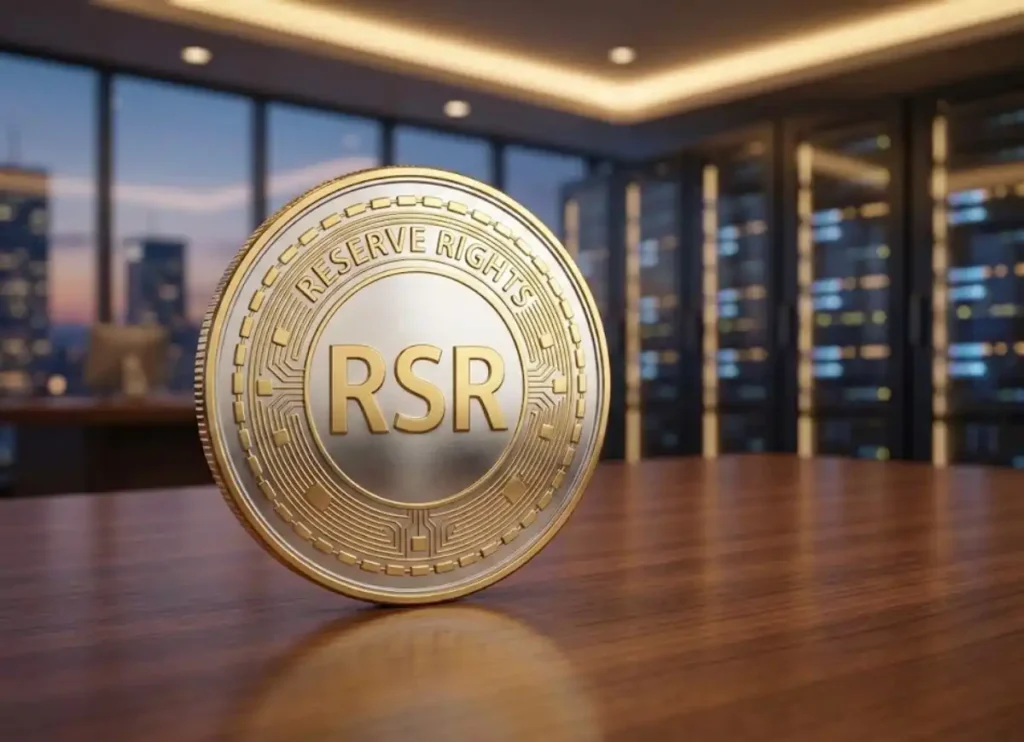

While the crypto market is flooded with thousands of projects, very few address a critical, real-world pain point: Hyperinflation.
Imagine going to the grocery store and seeing prices shift between your morning coffee and your evening commute. Or the panic of rushing to convert your paycheck into foreign currency the moment it hits your account to prevent it from melting away. for millions living in economies like Venezuela, Argentina, or Turkey, this isn’t a dystopian scenario—it is the harsh reality of daily life.
This is where the Reserve Protocol and its governance token, Reserve Rights (RSR), step in. They are designed specifically to solve this problem.
In this guide, we will strip away the complex jargon and explore exactly what RSR is, how it functions as a “safety net,” and what the future holds for this project—all without the dense technical noise.





Featured News Headlines
The Reserve Protocol: More Than Just a Coin
To understand RSR, we first need to grasp the goal of the “Reserve Protocol.”
The Reserve Protocol is a platform running on the Ethereum blockchain that allows anyone to create their own stablecoins. However, these stablecoins (referred to as RTokens) are fundamentally different from the USDT or USDC you might be used to.
Traditional stablecoins are typically backed by fiat currency (dollars) held in a bank account. Assets on the Reserve Protocol, however, are backed by diversified baskets of crypto assets (DeFi tokens, other stablecoins, etc.). This structure eliminates the reliance on a centralized bank or entity.
The Distinction Between RSR and RTokens
This is the point that confuses most investors. There are two distinct players in this ecosystem:
- RToken (e.g., eUSD): These are spendable, transferable assets usually pegged to $1.00. This is what a user holds to protect their purchasing power against inflation.
- Reserve Rights (RSR): The main subject of this article. RSR serves as the insurance policy and the governance mechanism for the entire system.
How RSR Works: The “Insurance” Analogy
The best way to understand the utility of RSR is to think of it as insurance underwriting.
Let’s assume there is a stablecoin built on the protocol called eUSD. For eUSD to maintain its $1.00 peg, it holds collateral in the background (for example, a mix of USDC and USDT).
What happens if there is a market crash and one of those collateral assets (say, USDC) de-pegs or fails? The value of eUSD could theoretically drop below $1.00. This is where RSR enters the stage.
- RSR Holders (Stakers): Investors lock (stake) their RSR tokens into the protocol to secure it.
- The Crisis Moment: If the collateral basket loses value, the protocol automatically sells the staked RSR tokens to cover the loss and recapitalize the stablecoin.
- The Reward: Why would RSR holders risk their assets being sold? Because as long as the system operates smoothly, they receive a share of the revenue and transaction fees generated by the RTokens.
In short: RSR holders are effectively underwriting the stability of the system. They are betting on the protocol’s success and, in return, they earn a yield.
Key Features of the Reserve Rights (RSR) Token
For investors and tech enthusiasts, the project stands out due to three core technical pillars:
1. Over-Collateralization
RTokens within the system are designed to be backed by assets worth more than the RTokens themselves. This mechanism acts as a buffer to ensure user funds remain secure even during market volatility.
2. Governance
RSR is a Governance Token. Holders who stake their tokens have the right to vote on the future of the protocol. Decisions such as which assets can be used as collateral or the creation of new RTokens are driven by the community.
3. The Arbitrage Mechanism
If an RToken’s price drifts above or below $1.00, arbitrageurs within the protocol step in. They profit from these small price discrepancies, and in doing so, they force the price back to its target peg. It is a seamless balance maintained by free-market dynamics.
Why Does RSR Matter? Use Cases and Potential
While many crypto projects feel like “a solution looking for a problem,” Reserve Rights addresses a bleeding wound in the global economy.
- The Latin America Use Case: The Reserve App has seen significant adoption in countries like Venezuela and Argentina. People use it to convert their eroding local currency into RTokens (like RSV) to preserve their wealth. This proves the project has tangible, practical utility.
- Inflation Hedging: RTokens don’t have to be pegged just to the dollar. They can be pegged to baskets of commodities, gold, or equities. This turns the Reserve ecosystem into a massive financial toolkit.
- DeFi Integration: RSR has the potential to become a cornerstone of Decentralized Finance (DeFi). Its ability to integrate with platforms like Curve, Aave, and Compound enhances liquidity and usability.
Risks to Consider Before Investing
No honest financial guide is complete without a discussion of risk. While RSR is built on a professional framework, you must not ignore the following:
- Smart Contract Risk: As with any DeFi project, a bug in the code could lead to an exploit. While the Reserve team undergoes regular audits, the risk is never zero.
- Slashing Risk: If you stake your RSR and the RToken you are insuring suffers a collateral failure, a portion of your RSR will be seized and sold to cover the debt. This is the cost of earning yield.
- Regulation: Governments are taking a harder look at stablecoins. Strict regulations could negatively impact projects like Reserve.
Does Reserve Rights Have a Future?
Reserve Rights (RSR) is not merely a speculative vehicle; it is a technological response to the instability and inequality of the traditional financial system. The fact that it received early backing from Silicon Valley heavyweights like Peter Thiel and Sam Altman (CEO of OpenAI) speaks volumes about the magnitude of its vision.
If you believe blockchain technology should be used not just to “get rich,” but to simplify lives and protect savings, RSR is a project worth watching. However, remember that RSR is the “insurer.” Its value is directly correlated to the growth of the Reserve ecosystem (RTokens).
If the ecosystem grows, the insurer (RSR) wins.






























Comments are closed.