



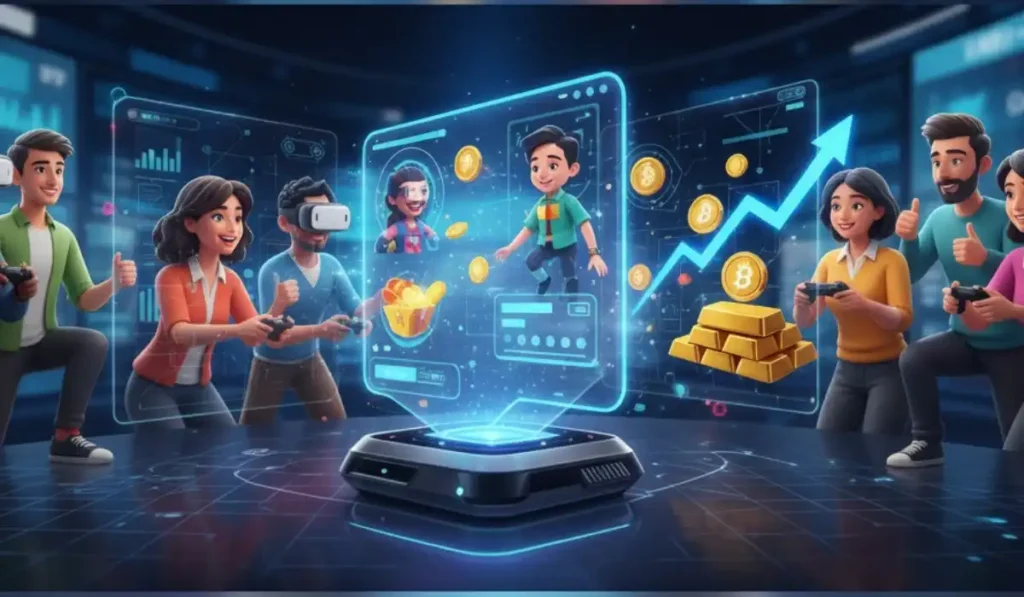

The gaming industry is currently undergoing perhaps one of the largest economic transformations in its history. Video games, once merely considered a leisure activity or hobby, have rapidly evolved into a global source of income and a new financial ecosystem with the rise of the Play to Earn (P2E) model. P2E is a groundbreaking concept that enables players to convert the time and skill they invest in a game into digital assets with real-world value.
In this detailed guide, we will delve into the meaning of P2E, its key differences from traditional gaming, its operational mechanics, its potential, and the crucial points for anyone looking to participate in this novel digital economy.
Featured News Headlines
Understanding the Fundamentals of the Play to Earn (P2E) Concept
Play to Earn, as the name explicitly states, signifies “Earn by Playing.” This model represents a new genre of video games that positions players at the centre of the game’s ecosystem, rather than the game developers.
The P2E Philosophy Versus Traditional Gaming
In the conventional gaming model, players purchase and play content created by game studios, acquiring in-game progress or items. However, the genuine ownership of these assets remains perpetually with the game studio. When players decide to leave the game, they are unable to recover the value of the time and money they have invested.





P2E, conversely, fundamentally overturns this system:
- Player Ownership: P2E games primarily leverage Blockchain technology and NFTs (Non-Fungible Tokens). This mechanism ensures that characters, weapons, virtual land, or other items that players earn or generate within the game are minted as NFTs.
- Real-World Value: Players can buy, sell, or trade these NFTs or the in-game cryptocurrencies they possess for fiat currencies in the game’s marketplace or on global crypto exchanges. This establishes that the player’s effort within the game now carries tangible economic value.
- Fair Economy: The game’s economy is often structured to be more transparent and decentralised, being managed or influenced by the players and the community, rather than a single central authority.
How Does P2E Function? The Role of Blockchain and NFTs
At the core of the P2E model are Blockchain technology and NFTs. These two elements confer uniqueness and verifiable ownership to in-game assets.
1. NFTs: The Proof of Digital Ownership
Every valuable item within the game (a rare sword, a special character, or a parcel of virtual land) is created as an NFT. NFTs are unique digital certificates recorded on the blockchain, which guarantee:
- Uniqueness: Each NFT possesses its own distinct identity and cannot be duplicated. This naturally increases the rarity and, consequently, the value of the in-game item.
- Transferability: Players can hold their NFTs in their personal crypto wallets, independently of the game, and can sell or gift them to another player. This capability grants the player true ownership of the assets.
2. Cryptocurrencies (Tokens): The Economic Lifeblood of the Game
P2E games generally employ two types of tokens:
- Governance Tokens: These tokens grant voting rights regarding the future of the game and are often viewed more as an investment vehicle (e.g., Axie Infinity Shard – $AXS).
- In-Game Utility Tokens: These are earned through activities like completing quests, winning battles, or farming, and are used for in-game purchases, trades, and rewards (e.g., Smooth Love Potion – $SLP).
Players can convert these earned tokens into fiat currency (GBP, USD, EUR, etc.) via cryptocurrency exchanges.
Revenue Streams in P2E Games
There are multiple avenues for generating income within the P2E model. These methods vary based on the game’s genre and economic design:
- Completing Quests and Battles: Earning in-game tokens by actively playing the game, fulfilling missions, or engaging in combat with other players.
- NFT Trading (Flipping): Collecting rare or strategically important NFT items and selling them for a higher price on in-game or external marketplaces when their value appreciates.
- Virtual Real Estate: Purchasing virtual plots of land in games like The Sandbox or Decentraland, hosting events on them, selling advertising space, or leasing the land for rental income.
- Staking and Yield Farming: Generating passive income by locking up owned game tokens within the game’s platform.
- Content Creation (UGC): Introducing player-designed content, mini-games, or items into the ecosystem and earning a commission from the sales of these assets.
- Scholarship Systems (Guilds): In games with a higher barrier to entry, investors (owners) lend their assets (NFTs) to lower-capitalised players (scholars) and share the generated revenue. This is a crucial element that increases the mass accessibility of P2E.
The Risks and Sustainability Concerns of P2E
While the Play to Earn model harbours immense potential, it is also accompanied by certain significant risks and challenges.
1. Economic Sustainability (Tokenomics)
The tokenomics—the economic model governing the flow of tokens—of a P2E game determines its longevity. If a game’s token is constantly being minted without corresponding new capital injection or token burning mechanisms, the token’s value is likely to plummet, potentially leading to an economic collapse. A sustainable P2E model demands that the token maintains continuous utility.
2. Barriers to Entry and Initial Investment (Gaslighting)
Starting certain P2E games may require a substantial initial investment to acquire the necessary NFT characters or assets. This can pose a significant hurdle, particularly for novice players.
3. Security and Scams
As with any project in the crypto and NFT space, the P2E sector is prone to fraudulent schemes, commonly known as “rug pulls.” It is absolutely vital for players and investors to conduct thorough research on the game’s development team, roadmap, and community before committing any investment.
The Future of P2E and the Concept of GameFi
P2E is expanding beyond being merely a game genre, evolving into the foundation of a colossal industry known as GameFi (Gaming Finance). GameFi gamifies decentralised finance (DeFi) mechanisms, creating an ecosystem where players can both enjoy themselves and participate financially.
The future of P2E hinges on projects that offer a high-quality gaming experience alongside a sustainable economic model. Following the initial wave of simple, “earn-focused” games, projects that boast superior graphics, deep gameplay, and genuine entertainment value (e.g., Illuvium, The Sandbox) are now coming to the fore. Game developers are now actively seeking a balance where players are primarily enjoying the gameplay, with financial rewards serving as an added bonus.
In conclusion, Play to Earn (P2E) is not just a passing trend; it is the integration of digital ownership and decentralised economics into the world of gaming. This model, which empowers players to gain real economic value from their time, is poised to become a critical component of the future internet experience (Web3). Nevertheless, potential investors and players must always exercise due diligence (DYOR) and be fully aware of the inherent risks within this dynamic ecosystem.
























[…] meets the financial might of cryptocurrency. It stands as the standard-bearer for the “Play-to-Earn” (P2E) […]