





Featured News Headlines
Stablecoin Market Cap Nears $290B Despite Drop in On-Chain Activity
The stablecoin market has seen an explosive surge in demand, recording more than $46 billion in net inflows over the past 90 days, according to data from RWA.xyz. The sharp rise underscores the growing appetite for US dollar-pegged assets in the crypto space, with both established players and newer entrants contributing to the momentum.
Tether and USDC Lead the Pack
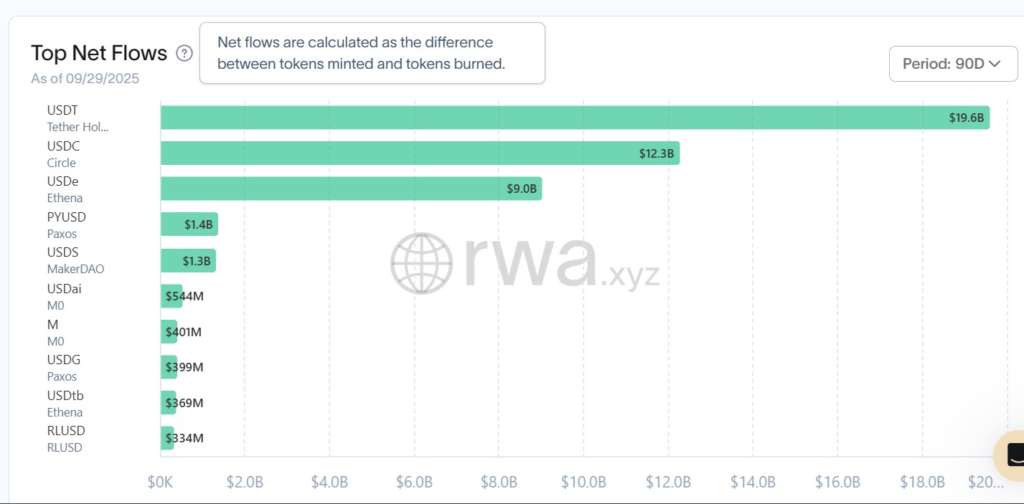
Tether’s USDT led the quarter, adding $19.6 billion in net inflows, while Circle’s USDC followed with $12.3 billion. A standout performer was Ethena’s synthetic stablecoin USDe, which amassed $9 billion in inflows, marking one of the fastest expansions among algorithmic stablecoins.
Other notable contributions came from PayPal USD (PYUSD) with $1.4 billion and MakerDAO’s USDS with $1.3 billion. Emerging projects such as Ripple’s RLUSD and Ethena’s USDtb also posted steady growth, signaling broader diversification within the stablecoin sector.
Quarterly Growth Accelerates
Stablecoin inflows grew by more than 324% over the past six months, totaling $56.5 billion. While the second quarter saw just $10.8 billion, the third quarter accounted for the lion’s share of activity. Tether maintained dominance with consistent minting, while USDC’s net issuance skyrocketed from only $500 million in Q2 to over $12 billion in Q3.





Ethena’s USDe also saw its biggest leap this quarter, climbing from a modest $200 million inflow in Q2 to $9 billion in Q3.
Ethereum Remains Stablecoin Hub
Ethereum continues to dominate as the leading network for stablecoins, hosting $171 billion in circulating supply. Tron ranks second with $76 billion, while Solana, Arbitrum, and BNB Chain collectively hold $29.7 billion.
By market share, Tether controls nearly 59%, followed by USDC at 25%, while USDe claims close to 5%, according to DefiLlama.
Market Metrics Show Mixed Signals
The overall stablecoin market cap rose to around $290 billion in the last 30 days. However, other activity metrics cooled. Monthly active addresses fell 22.6% to 26 million, and transfer volumes declined 11% to $3.17 trillion, suggesting that while demand is rising, user activity has slowed.



























Comments are closed.