





Featured News Headlines
Grayscale Predicts Bitcoin to Reach New All-Time High in 2026
Grayscale analysts are projecting a renewed expansion in the crypto market, suggesting that strengthening demand could lift Bitcoin to a new all-time high in the first half of 2026. The outlook was shared in the asset manager’s latest 2026 market report, published on Monday, which outlines ten major investment themes expected to shape the year.
Bitcoin Outlook Anchored in Macro Demand
In its assessment of Bitcoin, Grayscale highlighted growing macroeconomic interest in alternative stores of value as a key driver. The firm pointed to concerns around fiat currency debasement, rising public sector debt, and long-term inflation risks as factors likely to sustain institutional and portfolio-level demand.
According to the report, Bitcoin’s potential surge would also coincide with a structural shift in market behavior. Grayscale stated:
“We expect rising valuations in 2026 and the end of the so-called ‘four-year cycle,’ or the theory that crypto market direction follows a recurring four-year pattern. Bitcoin’s price will likely reach a new all-time high in the first half of the year, in our view.”





The firm added that as long as pressures on traditional currencies persist, demand for digital assets such as Bitcoin and Ether is expected to remain resilient.
Regulatory Momentum Supports Market Growth
Grayscale also emphasized the changing regulatory environment in the United States as a major catalyst. Over the past two years, the firm observed a more constructive stance from policymakers and regulators toward the digital asset industry.
The report referenced several developments, including the dismissal of enforcement actions against crypto firms, the approval of spot Bitcoin exchange-traded products, and the passage of the GENIUS Act governing stablecoins.
Reflecting on recent progress, Grayscale noted:
“In 2024, Bitcoin and Ether spot ETPs came to market. In 2025, Congress passed the GENIUS Act on stablecoins and regulators shifted their approach toward crypto, working with the industry to provide clear guidance while continuing to focus on consumer protection and financial stability.”
Looking ahead, the firm expects bipartisan crypto market structure legislation to emerge in 2026, potentially reinforcing blockchain-based finance within U.S. capital markets and supporting ongoing institutional participation.
Ten Key Themes Shaping Crypto in 2026
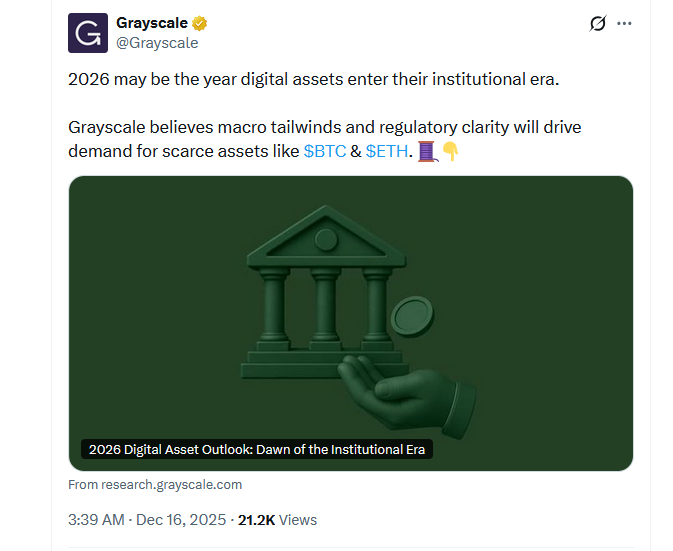
Beyond Bitcoin, Grayscale outlined ten major investment themes it believes will define the crypto landscape in 2026. These themes reflect expanding real-world applications of public blockchain technology and growing institutional adoption.
Key areas highlighted include accelerated stablecoin growth following regulatory clarity, asset tokenization reaching a critical inflection point, and renewed expansion in decentralized finance—particularly lending markets. The report also suggested that staking could become a default consideration for investors.
Grayscale described the anticipated evolution of stablecoins in detail, stating:
“In 2026 we expect to see the practical results: stablecoins integrated into cross-border payment services, stablecoins as collateral on derivatives exchanges, stablecoins on corporate balance sheets, and stablecoins as an alternative to credit cards in online consumer payments.”
Narratives Expected to Have Limited Impact
The report also identified two high-profile narratives that Grayscale believes are unlikely to significantly influence crypto valuations in 2026. These include quantum computing risks and digital asset treasuries (DATs).
On quantum computing, the firm commented:
“We believe that research and preparedness will continue on post-quantum cryptography, but this issue is unlikely to affect valuations in the next year.”
Regarding DATs, Grayscale added that despite media attention, they are not expected to be a decisive market factor in the year ahead.
Overall, the report paints a picture of a maturing crypto market shaped by regulation, macroeconomic forces, and expanding real-world use cases.


























Comments are closed.