



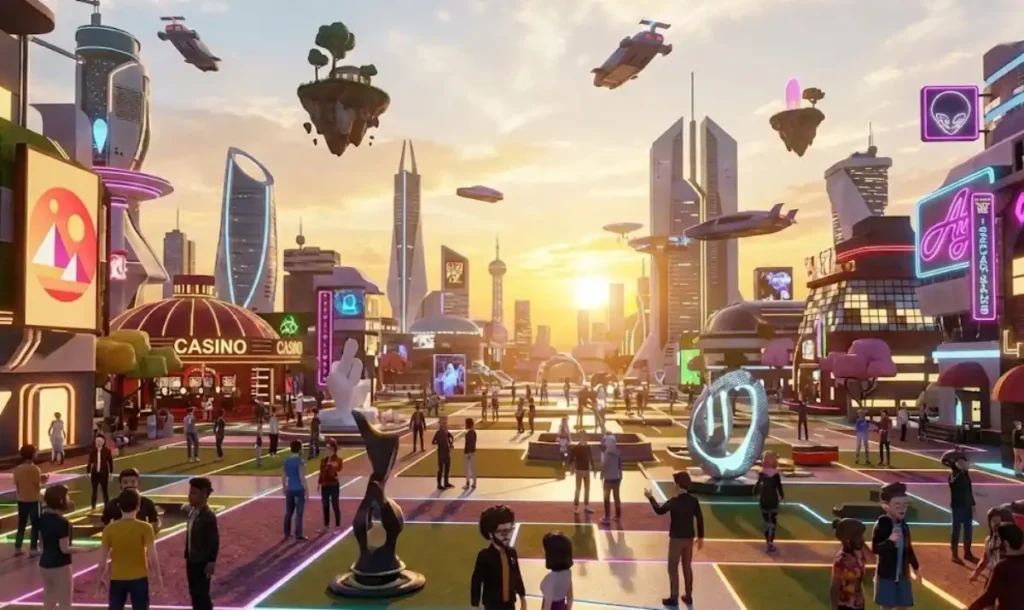

In recent years, the concept of the “Metaverse” has swept through the technology landscape, transcending the realm of science fiction to become a digital reality. While Facebook’s rebranding to “Meta” ignited the initial spark, Decentraland has cemented itself as one of the most significant platforms in this space, distinguished by its decentralized architecture. But what exactly is Decentraland (MANA)? Is it merely a game, or does it represent the future of real estate markets?
In this guide, we will bypass the dense technical jargon to explore this virtual world built on the Ethereum blockchain. We will examine its economy and the limitless freedom it offers its users, all presented in clear, accessible language.
Featured News Headlines
- 1 What is Decentraland? Core Concepts
- 2 How Does Decentraland Work? The Two Pillars: MANA and LAND
- 3 Governance via Decentralized Autonomous Organization (DAO)
- 4 What Can You Do in the Decentraland Universe?
- 5 Why is Decentraland (MANA) Valuable?
- 6 Risks and Considerations
- 7 A Glimpse into the Future of the Internet
What is Decentraland? Core Concepts
In its simplest definition, Decentraland is a three-dimensional virtual reality platform built on the Ethereum blockchain that is owned, governed, and developed by its users.
Unlike traditional games (such as The Sims or World of Warcraft), there is no single central authority dictating the rules in Decentraland. Every plot of land, building, artwork, and wearable item you see in this universe belongs to the users. Users can create these digital assets, experience them, and, most importantly, monetize them through trade.




The project was co-founded by Ari Meilich and Esteban Ordano and came to life following a $24 million ICO (Initial Coin Offering) in 2017. Since opening to the public in 2020, it has positioned itself as the strongest bastion of digital ownership.
How Does Decentraland Work? The Two Pillars: MANA and LAND
To understand the Decentraland ecosystem, one must understand the two primary building blocks that drive its economy: MANA and LAND.
1. What is MANA?
MANA is the official cryptocurrency of Decentraland. It is an ERC-20 standard Ethereum token. MANA is used for all transactions within the platform—whether purchasing land, buying avatar wearables, or paying for services. Furthermore, holding MANA in your wallet is a prerequisite for voting on decisions regarding the platform’s future.
- Economic Note: MANA is subject to a “burn” mechanism. This means that when LAND is purchased, a portion of the MANA used is permanently removed from circulation. Theoretically, this reduction in supply can drive up the value of the remaining tokens.
2. What is LAND?
LAND represents the digital parcels of real estate within the Decentraland universe. Each piece of LAND is a NFT (Non-Fungible Token), specifically an ERC-721 token, containing unique data.
- The Decentraland universe consists of a finite number of LAND parcels (90,601 in total).
- Each parcel has specific, immutable (x, y) coordinates.
- LAND owners have total freedom to build whatever they desire on their property: an art gallery, a gaming park, a 3D cinema, or an e-commerce storefront.
Governance via Decentralized Autonomous Organization (DAO)
The defining feature that sets Decentraland apart from its competitors is that it is genuinely governed by its users. This structure is known as a DAO (Decentralized Autonomous Organization).
In traditional gaming, a developer company could wake up one morning and unilaterally decide to “change the rules of the game.” In Decentraland, however, the power lies with the community.
- Content moderation policies,
- Land auctions,
- MANA economics,
- System upgrades,
…are all determined by votes cast by MANA and LAND holders. This is a prime example of digital democracy and serves as a safeguard for the platform’s long-term sustainability.
What Can You Do in the Decentraland Universe?
The answer to “What is Decentraland (MANA)?” lies not just in its technical infrastructure, but in the experience it offers. When you log in (no VR headset required; you can access it directly via a browser), here is what awaits you:
1. Digital Real Estate Investment and Development
Users can purchase strategic plots of land on the main map, known as Genesis City. Just like in the physical world, “location” is everything. Parcels near popular districts (such as Fashion Street or Crypto Valley) can command valuations in the millions of dollars. You can buy land, construct a building upon it, and lease it out to others.
2. Art Galleries and NFT Trading
World-renowned auction houses like Sotheby’s have opened virtual branches within Decentraland. Artists can exhibit their work as NFTs, and visitors can purchase these pieces instantly.
3. Events and Concerts
Celebrities such as Paris Hilton and Deadmau5 have hosted concerts here. During events like Metaverse Fashion Week, brands like Dolce & Gabbana showcase their digital collections. You can attend these parties with your avatar and socialize with people from around the globe.
4. Games Within the Game (Play-to-Earn)
Decentraland hosts mini-games developed by other users. By playing these games, you have the opportunity to earn NFTs or cryptocurrency.
Why is Decentraland (MANA) Valuable?
There are several fundamental reasons why investors and tech enthusiasts are drawn to MANA:
- Scarcity: The supply of LAND is fixed. As demand rises, the value of this limited digital real estate tends to increase.
- Institutional Adoption: Major corporations like Samsung, Adidas, Atari, and PwC purchasing land or advertising on Decentraland significantly boosts confidence in the project.
- True Ownership: Even if the “game” were to shut down, your assets on the blockchain would remain in your wallet. This is the guarantee of digital property rights.
- Growing Ecosystem: The fact that it is not just a game, but a social network and a commercial platform, transforms it from a speculative asset into a tangible, usable product.
Risks and Considerations
As with any cryptocurrency project, Decentraland carries inherent risks.
- Volatility: The price of MANA can experience sharp fluctuations in line with the broader crypto market.
- Competition: Strong competitors exist, such as The Sandbox, Axie Infinity, or Meta’s proprietary projects.
- Technical Barriers: A high-end experience may require a capable computer and a strong internet connection. Additionally, high transaction costs (gas fees) on the Ethereum network can sometimes be a barrier for smaller investors (though the integration of the Polygon network has largely mitigated this issue).
A Glimpse into the Future of the Internet
In summary, Decentraland (MANA) is more than just a cryptocurrency; it is a living prototype of Web 3.0, widely regarded as the future of the internet. By granting users the right to be “owners” rather than mere “consumers,” this platform heralds a new world where digital boundaries are dissolving.
Whether you are an investor, a gamer, or simply a curious tech observer, stepping into the Decentraland universe is one of the best ways to understand how our digital future is taking shape.




















Comments are closed.