




Blockchain technology initiated a revolution, fundamentally transforming the way the digital world handles finance and data management. However, the inherent challenges of scalability and interoperability faced by first-generation chains, such as Bitcoin and Ethereum, have been the most significant hurdles preventing this technology from reaching its full potential. It is precisely at this juncture that a groundbreaking concept emerges, offering revolutionary solutions to these core problems, primarily through the Polkadot and Kusama networks: the Parachain.
So, what is a Parachain, and why does it hold such a critical role within the blockchain ecosystem?
Featured News Headlines
The Core Definition of Parachains: Parallel Chains
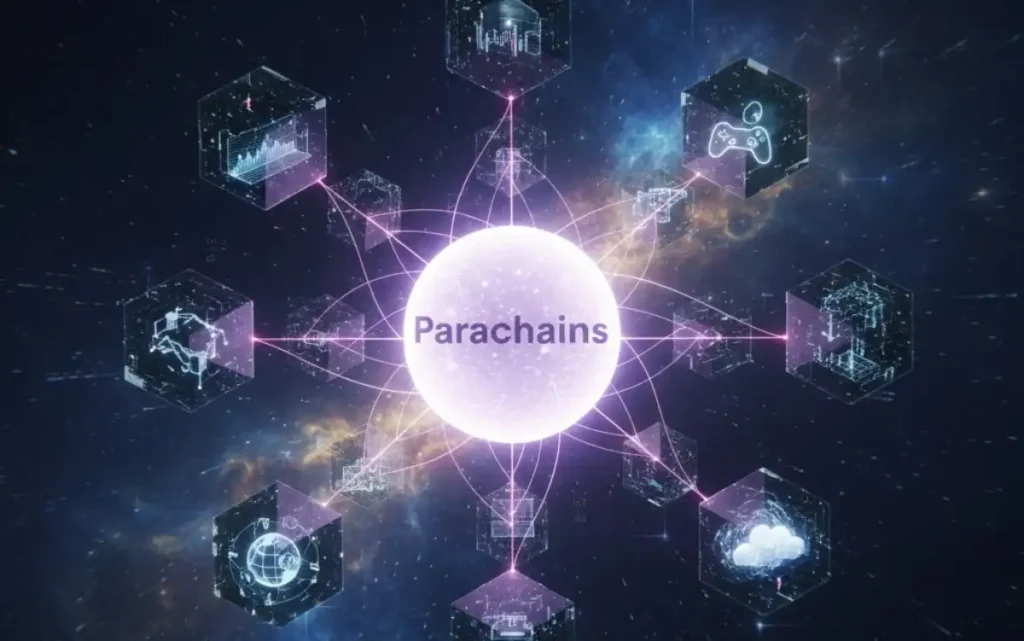
The term “Parachain” is a portmanteau derived from “Parallel Chain.” At its most fundamental level, a Parachain is a specialized, independent Layer-1 blockchain that operates by connecting to a central chain known as the Relay Chain, which is central to the architecture developed by Polkadot.
By operating in parallel with other blockchains within the network, Parachains dramatically increase the network’s overall transaction capacity and efficiency. Crucially, each Parachain can possess its own unique features, governance model, token economy, and specific use case.





Polkadot Architecture and the Relay Chain Relationship
To fully grasp Parachains, one must closely examine their surrounding ecosystem—the Polkadot multi-chain architecture:
- The Relay Chain: This is the heart and brain of the Polkadot and Kusama networks.
- Security: It provides shared security for all Parachains. Instead of maintaining their own consensus mechanism, Parachains leverage the security provided by the Relay Chain’s central set of Validators. This forms the basis of Polkadot’s “Shared Security” model.
- Coordination: It manages the coordination and consensus of all Parachains on the network.
- Parachains (Parallel Chains): These are the individual blockchains connected to the Relay Chain.
- Specialization: Each one is optimized for a specific need, such as DeFi (Decentralized Finance), gaming (GameFi), identity management, NFTs, or supply chains.
- Interoperability: Thanks to the Relay Chain, all forms of data and asset transfer can be seamlessly executed between Parachains using the Cross-Chain Message Passing (XCMP) protocol. This enables the blockchain ecosystem to evolve from “isolated islands” into a seamlessly connected whole.
- Collators: These are the specific nodes for each Parachain. They aggregate Parachain transactions, prepare a block proposal, and submit these blocks to the Validators on the Relay Chain for final confirmation.
Critical Advantages Offered by Parachain Technology
The Parachain structure offers several revolutionary advantages compared to traditional single-chain blockchains:
1. Superior Scalability
Parachains enhance the network’s overall throughput by processing transactions in parallel. While monolithic chains like Ethereum process all transactions sequentially, in Polkadot, each Parachain independently manages its own transaction volume under the Relay Chain’s security umbrella. This reduces congestion and exponentially increases the transactions per second (TPS).
For a project, establishing its own blockchain necessitates the costly and challenging task of building a security network (a network of Validators/Miners) from scratch. Parachains eliminate this burden by harnessing the power of the Relay Chain. New projects inherit Polkadot’s proven security directly, allowing them to focus solely on their application logic.
3. Flexibility and Customization
Parachains are built using a blockchain development framework called Substrate. This grants developers the ability to customize virtually every aspect of their chain—such as block times, transaction fees, governance mechanisms, and even the consensus algorithm—to suit their specific use case. A gaming Parachain might focus on low latency, while a DeFi Parachain might prioritize high transaction speed and security guarantees.
4. True Interoperability
Perhaps the most crucial advantage is the ease with which different Parachains can communicate with each other. This means tokens or data on one Parachain can be transferred to another Parachain in a trustless and permissionless manner. It resolves the “walled garden” problem in the blockchain industry and paves the way for complex, multi-chain decentralized applications (dApps).
Parachain Slot Auctions and Coretime
For a project to become a Parachain on the Polkadot or Kusama network, it must lease a limited “space” known as a Parachain Slot on the Relay Chain. These slots are typically allocated through an auction mechanism called Parachain Auctions:
- Candle Auction: The end time of the auctions is determined randomly (though this time is verifiably confirmed on-chain retroactively), a fair mechanism designed to prevent last-minute bidding (sniping).
- Crowdloan: Projects can temporarily borrow the required amount of DOT (Polkadot’s native token) from the community to bid in the auction. If successful, investors receive their locked DOT back at the end of the lease period, alongside an award of the project’s own tokens.
The Next Step: Coretime
Recent developments in the Polkadot ecosystem have introduced the concept of Coretime, a more flexible model than the leasing of Parachain slots. In this model, projects can purchase the block production time (i.e., the Relay Chain core) they need more flexibly, either instantly or periodically. This lowers the barrier to entry, particularly for smaller projects that do not require a permanent Parachain slot, and further enhances network efficiency.
The Multi-Chain Future of Web3
Parachains represent the next evolution of blockchain technology. Polkadot’s innovative architecture not only solves the scalability problem but also brings to life the vision of a highly customizable, shared-security Web3 ecosystem where different chains can communicate, and data and value flow freely.
Thanks to Parachains, developers can concentrate on user value and functionality rather than the technical infrastructure of their projects. This structure is playing a critical role in bringing blockchain technology into the mainstream and facilitating its widespread adoption in real-world applications.





























Comments are closed.