





Could Chainlink’s Symmetrical Triangle Signal a Major Move?
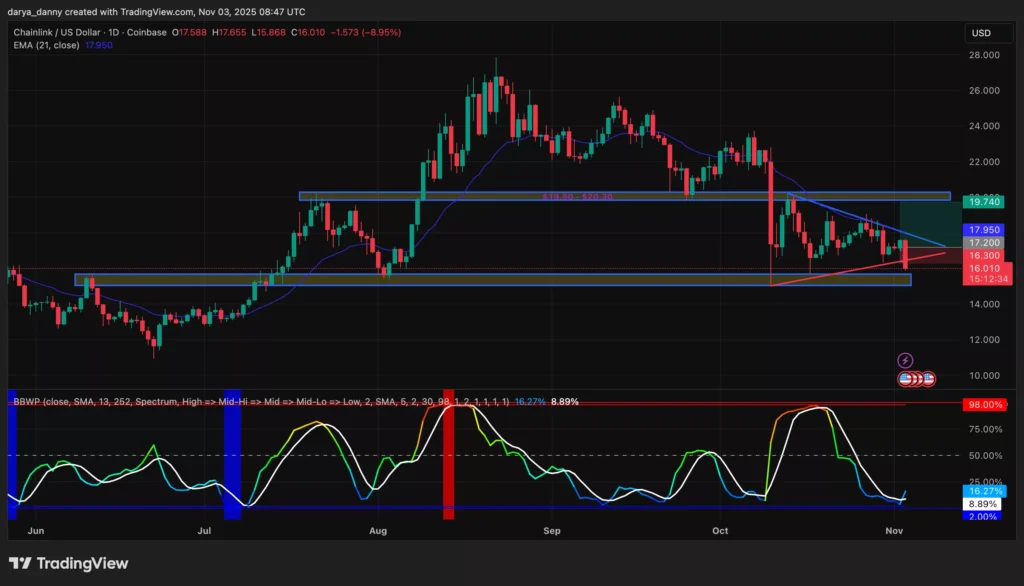
Chainlink (LINK) is showing signs of technical vulnerability, testing a crucial support level amid emerging bearish signals. After recently wicking below its ascending trendline support, LINK is flirting with a breakdown from a symmetrical triangle that has contained price action since the October 10 flash crash to $15. Symmetrical triangles often signal market indecision, reflecting the tug-of-war between bulls (lower highs) and bears (higher lows).
Technical Indicators Point to Possible Decline
The Bollinger Band Width Percentage (BBWP), which tracks volatility expansion, has registered a crossover above its moving average from an extreme low zone—an event often preceding significant price moves. With LINK slipping beneath the triangle’s support, the technical bias currently leans bearish.
If confirmed with a daily candle close below $16.50, analysts suggest Chainlink could experience a measured move toward $11.30, based on the triangle’s maximum height of $5.20 subtracted from the breakdown level. This scenario highlights the precarious position LINK occupies, even as underlying fundamentals show strength.
Fundamental Catalysts Could Counter Pressure
Despite short-term technical weakness, Chainlink’s fundamental outlook remains promising. Circle, the issuer of USDC, recently launched the testnet of Arc, a stablecoin-focused layer-2 network, with Chainlink providing essential oracle solutions for developers.





Additionally, Grayscale’s September filing to convert its existing Chainlink Trust into a spot ETF (potentially trading as GLNK) could act as a medium-term catalyst, attracting speculative capital and reinforcing bullish sentiment—if the ETF successfully navigates SEC review.
Chainlink stands at a crossroads, with bearish technical setups pushing prices toward key support while fundamental developments, including Arc and a potential spot ETF, may provide a counterbalance. Traders and observers are closely watching $16.50 as a pivotal level that could determine the next directional move for LINK.




























Comments are closed.