




Featured News Headlines
- 1 What is Render Token (RENDER)?
- 2 Render Token (RENDER) Fundamentals: Concepts and History
- 3 How Does the Render Network Work? The Anatomy of Decentralised Operation
- 4 RENDER Token Economics (Tokenomics)
- 5 Render Network’s Use Cases and Future Potential
- 6 Why the RENDER Token Matters
- 7 Frequently Asked Questions
What is Render Token (RENDER)?
In our rapidly digitising world, there is an enormous need for computing power to handle three-dimensional (3D) modelling, high-resolution animations, visual effects (VFX), and increasingly complex artificial intelligence (AI) applications. A significant portion of this power comes from Graphics Processing Units (GPUs), which are crucial for computationally intensive tasks like rendering and training AI models.
However, accessing this power through traditional methods is often expensive, slow, and centralised. For individual artists and small studios, the cost of acquiring professional-grade hardware or using expensive centralised cloud rendering services is a major barrier.
This is precisely where the Render Network and its native utility token, RENDER, come into play, offering a decentralised, cost-effective, and global alternative to the traditional cloud computing model.
Render Token (RENDER) Fundamentals: Concepts and History
What is the Render Network?
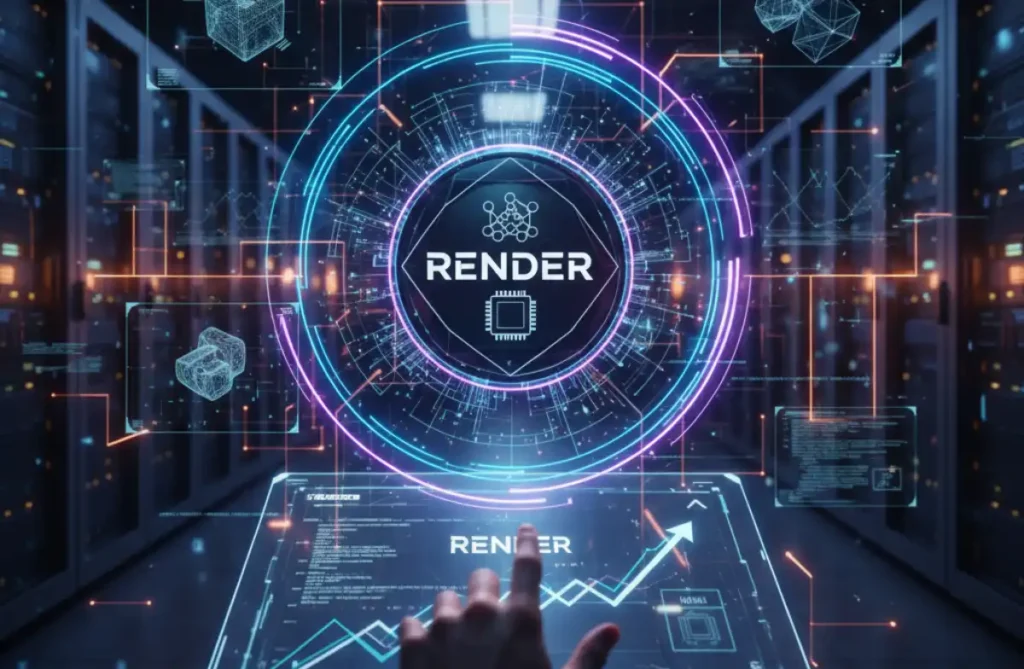
The Render Network is a decentralised GPU rendering platform that connects idle GPU power with creators who need rendering and other computationally intensive services. Simply put, it aggregates the unused graphics card capacity from thousands of computers around the world to create a massive, global, virtual “supercomputer” network.



This network provides 3D artists, filmmakers, game developers, and AI researchers with a solution that is scalable, fast, and more affordable compared to centralised services.
What is the RENDER Token?
The RENDER token is the native utility cryptocurrency of the Render Network. All transactions within the network are facilitated through this token.
- Artists and Creators: Purchase and use RENDER tokens to pay for rendering services.
- Node Operators: Contribute their spare GPU power to the network to complete rendering jobs and earn RENDER tokens as a reward in return.
The token acts as the principal medium of exchange, powering the ecosystem’s economic cycle and incentivising the network’s continuous expansion.
History and the Migration to Solana (RNDR to RENDER)
The Render Network was originally launched on the Ethereum (ETH) blockchain as an ERC-20 token under the ticker RNDR. However, to cope with the network’s growing transaction volume, provide faster speeds, and reduce transaction fees (gas fees), a significant migration process was initiated following a community vote.
With this crucial transition, which took place in late 2023, the token was moved to the Solana (SOL) blockchain, and its new ticker was designated as RENDER. This shift allowed the Render Network to serve large-scale projects and AI workloads more effectively.
How Does the Render Network Work? The Anatomy of Decentralised Operation
The core operating mechanism of the Render Network is built upon innovative blockchain technologies like Escrow Smart Contracts and the Proof-of-Render (PoR) mechanism, eliminating the need for a central intermediary, unlike traditional business models.
A. Creators
- Project Upload: A 3D artist or studio uploads their scene that requires rendering (e.g., an animation frame or a 3D model) to the network. The project must be compatible with one of the supported render engines, such as OctaneRender.
- Cost Calculation and Payment: The network automatically calculates the estimated cost in RENDER tokens based on the project’s complexity. The creator locks these tokens into an escrow account (smart contract).
- Job Distribution: The smart contract breaks down the rendering job into smaller tasks and distributes them among suitable Node Operators on the network.
B. Node Operators
- Power Contribution: A user anywhere in the world connects their idle GPU to the network, becoming a “Node Operator.”
- Processing and Rendering: The nodes process the small rendering tasks assigned to them and return the results to the network upon completion.
- Receiving Payment: Once the job is completed and manually verified by the creator, the RENDER tokens locked in the smart contract are automatically and securely released to the Node Operators.
C. The Proof-of-Render (PoR) Mechanism
PoR is the network’s quality control mechanism, ensuring that the work is performed accurately and completely. The rendered parts completed by the nodes are verified by the smart contract, maintaining the quality of service. The Escrow system—where the payment is locked during the process—guarantees that the artist’s job will be completed and the Node Operator will be fairly compensated for their effort.
RENDER Token Economics (Tokenomics)
The economic model of the RENDER token is designed to ensure the network’s sustainability and establish an incentive structure for all participants.
The Supply and Demand Cycle
- Demand Side: Growth in areas like 3D, VFX, AI, and the Metaverse increases the demand for rendering services. This directly boosts the demand for the RENDER token, as services can only be purchased with this currency.
- Supply Side: The supply of GPU power from Node Operators is constantly fuelled by the motivation to earn RENDER.
Burn and Mint Equilibrium (BME)
The Render Network utilises a dynamic mechanism called BME to maintain price stability and long-term sustainability:
- Burning: A significant percentage (like 95%) of RENDER tokens paid by creators for rendering services is permanently removed from circulation (burnt). This creates deflationary pressure, helping to preserve the token’s value.
- Minting: Simultaneously, a certain amount of new RENDER tokens are minted and distributed as rewards to compensate Node Operators for their contributions.
This burn and mint equilibrium is adjusted based on market conditions and network usage, aiming for controlled and sustainable long-term growth of the network.
Maximum Supply and Governance
The total supply of the RENDER token is capped (with a maximum supply of around 644 million). Furthermore, RENDER token holders have the right to participate in the network’s future development, upgrades, and decisions by voting on Render Network Proposals (RNPs). This makes the token a governance token as well.
Render Network’s Use Cases and Future Potential
Thanks to its decentralised GPU power, the Render Network is not limited to visual arts; it offers groundbreaking opportunities across many sectors of the digital economy.
Visual Arts and Production
- Film and Animation: Significantly reduces the time and cost for high-quality cinematic renders for both studios and independent producers.
- Game Development: Enables the rapid rendering of in-game graphics, cinematics, and complex 3D environments. It is compatible with popular tools like Unreal Engine and Blender.
- NFTs and the Metaverse: Provides the necessary computational power for creating high-resolution digital collectibles (NFTs) and virtual/augmented reality (VR/AR) experiences.
Artificial Intelligence (AI) and Machine Learning
One of the largest and newest use cases for the Render Network is its potential as a decentralised AI infrastructure. Training and inference for AI models require massive GPU power. By leveraging idle GPUs for this purpose, the Render Network aims to create a more affordable and accessible AI compute layer compared to traditional centralised cloud solutions. This potential is critical for the RENDER token’s future value and utility.
Decentralised Physical Infrastructure Networks (DePIN)
The Render Network is fundamentally a DePIN (Decentralised Physical Infrastructure Network) project. By providing real-world services (rendering and AI compute) through physical hardware (in this case, GPUs), these networks form an essential part of the Web3 ecosystem, positioning RENDER as a leading project in this field.
Why the RENDER Token Matters
The RENDER Token (RENDER) and the Render Network it powers are playing a critical role in the future of digital creativity and AI technologies.
- Democratisation: It makes GPU power accessible to everyone by removing high-cost barriers. Individual artists can access the processing power needed to compete with large studios.
- Efficiency: It increases energy efficiency and social benefit by utilising idle global GPU resources.
- Decentralisation: It ensures the continuity of service and fair distribution through transparent and reliable smart contracts, without reliance on a single corporate entity.
RENDER is not just a cryptocurrency; it is a utility token with tangible value, serving as the engine of creativity and innovation in the decentralised compute world. As the payment instrument for high-demand rendering and AI services, it bridges the gap between the blockchain and real-world applications.
As the digital economy deepens and the role of artificial intelligence in our lives increases, the decentralised, scalable GPU solutions offered by the Render Network will continue to be one of the fundamental building blocks constructing the digital world of the future.
Frequently Asked Questions













Comments are closed.