





Featured News Headlines
Bitcoin Supporters Slam Vietnam’s Biometric Bank Account Closures as Financial Overreach
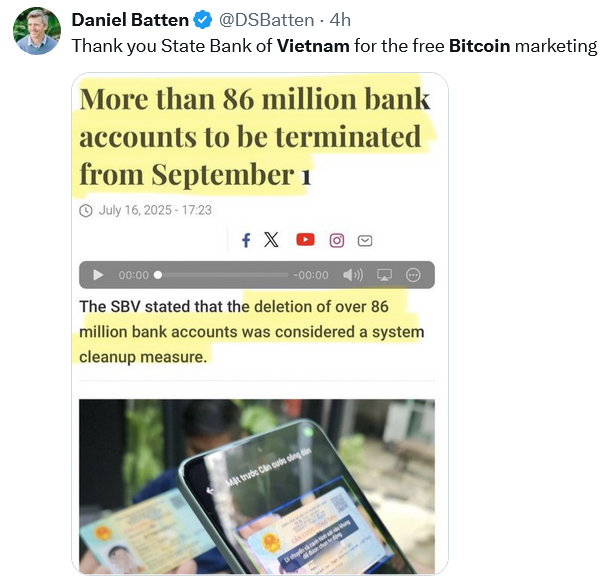
Bitcoin advocates are reigniting the conversation around financial freedom after Vietnam enforced a strict facial biometric authentication law that led to the closure of more than 86 million bank accounts.
86 Million Accounts Closed Over Biometric Rules
Local media reports revealed that, as of September 1, Vietnam began shutting down bank accounts that failed to comply with the new mandate. While around 113 million accounts were successfully verified, millions of customers were left scrambling to meet the requirements.

For some, the law has created major hurdles. One Reddit user, a foreign contractor in Vietnam, said he had to fly back into the country to update his HSBC account, since no remote solution was offered. “You cannot transfer your money and have to fly into a country in person to resolve an issue,” he wrote, calling the situation “crazy” in 2025.
Bitcoin Advocates Say “This Is Why We Bitcoin”
The policy has fueled arguments from the Bitcoin community, which has long promoted the idea of self-sovereign money. Industry commentator Marty Bent argued that measures like this highlight the need for permissionless monetary systems. “If users don’t comply by the 30th [of September], they’ll lose their money. This is why we Bitcoin,” he said.





Analyst Daniel Batten added that the law hands Vietnam’s central bank “next-gen financial surveillance ability”, reinforcing why Bitcoin can serve as a safeguard against state overreach.
Fighting Fraud With Biometrics
Vietnam’s central bank defended the law, citing the rise of AI-powered fraud. In May, police uncovered a $39 million money-laundering scheme using fake facial scans. Under the new rules, facial authentication is required for all new customers and for online transfers above 10 million dong ($379).
While some observers note the impact is more pronounced on foreign residents with inactive accounts, Bitcoin advocates argue the broader lesson is clear: centralized banking remains vulnerable to sudden government-imposed restrictions.



























Comments are closed.