




Featured News Headlines
- 1 What is a T-Address (Zcash)?
- 2 What is Zcash and Why is it Different?
- 3 What is a T-Address (Transparent Address)?
- 4 T-Address vs. Z-Address: The Key Differences
- 5 The Role of T-Addresses in Zcash Transactions
- 6 Use Cases and Advantages of T-Addresses
- 7 Disadvantages and Considerations of T-Addresses
- 8 Transitioning to Z-Addresses and Best Practices
- 9 Conclusion
What is a T-Address (Zcash)?
The Zcash ecosystem, with its foundation in financial privacy, holds a unique position in the world of cryptocurrencies. However, this privacy-centric structure also introduces certain concepts that many users are unfamiliar with. One of these is the T-Address. Most Zcash users wonder what T-Addresses are for, how they work, and why they exist in a privacy-focused blockchain. In this comprehensive guide, we will delve into the depths of T-Addresses, compare Zcash’s two different address types (T-Address and Z-Address), and explain the critical role these addresses play within the Zcash ecosystem.
What is Zcash and Why is it Different?
Zcash is a cryptocurrency built on the foundational protocol of Bitcoin, but it uses Zero-Knowledge Proofs to protect the privacy of financial transactions. This technology allows a transaction to be proven valid without revealing information like the sender, recipient, or transaction amount. This privacy mechanism is the most significant feature that distinguishes Zcash from Bitcoin, where transactions are fully traceable.
Zcash’s privacy capability is made possible by two different types of addresses:
- T-Address (Transparent Address): Much like Bitcoin, these addresses and the transactions conducted through them are visible and traceable on the blockchain for everyone to see.
- Z-Address (Shielded Address): These addresses and the transactions made through them are hidden on the blockchain using Zero-Knowledge Proof technology. The sender, recipient, and transaction amount information are all encrypted.
The focus of this guide is on T-Addresses, which act as a bridge between Zcash’s two different transaction types and play a critical role in the ecosystem’s operation.





What is a T-Address (Transparent Address)?
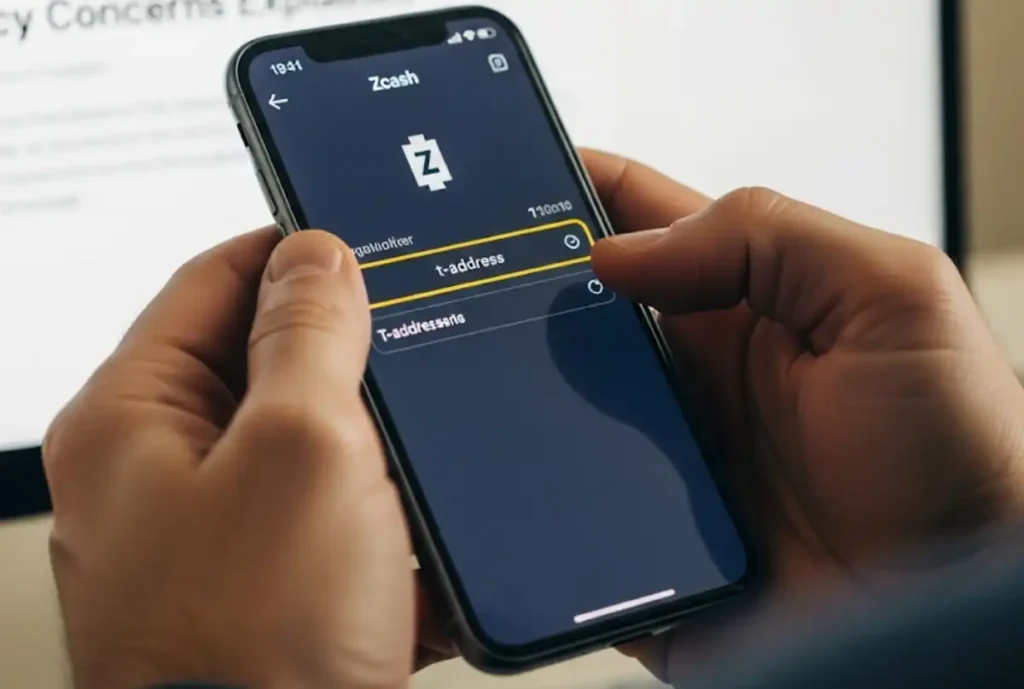
A T-Address, as its name suggests, is a Zcash address used for transparent or public transactions. A T-Address begins with t1 or t3, just like a Bitcoin address. Transactions made via these addresses are publicly visible, similar to transactions on Bitcoin’s blockchain.
So, why would a privacy-focused cryptocurrency like Zcash have transparent addresses? This is because Zcash offers privacy as an optional feature. Users are free to choose whether or not to use the privacy features. When a user makes a transaction using a T-Address, all transaction data (sender, recipient, amount) is recorded publicly on the blockchain. This gives the Zcash blockchain a similar level of visibility to other transparent cryptocurrencies like Bitcoin or Litecoin.
The Technical Structure of T-Addresses
T-Addresses have a structure very similar to Bitcoin’s address format. As in Bitcoin, a T-Address is created by hashing a public key and starts with t1 or t3. This is like your wallet’s public address. All transfers to this address can be easily tracked on the Zcash blockchain.
Example of a T-Address: t1cK8vD8S8eY4J8vK1N5L8E4X8G4E9H7F
This address is a Zcash user’s T-Address, and every transaction to this address can be viewed by anyone using a block explorer. This visibility makes T-Addresses practical, especially when dealing with centralised exchanges or KYC (Know Your Customer) processes that require legal compliance.
T-Address vs. Z-Address: The Key Differences
Understanding the difference between Zcash’s two address types is key to grasping its privacy mechanism.
| Feature | T-Address (Transparent) | Z-Address (Shielded) |
| Prefix | Starts with t1 or t3 | Starts with z |
| Privacy Level | Low. Transaction data (sender, recipient, amount) is public. | High. Transaction data is encrypted using Zero-Knowledge Proofs. |
| Traceability | Fully traceable via block explorers. | The existence of transactions is traceable, but the details are hidden. |
| Use Case | Centralised exchanges, KYC-required platforms, donations, and situations where transparency is desired. | Personal or commercial transactions requiring maximum privacy. |
| Technology | Similar to Bitcoin, using the UTXO (Unspent Transaction Output) model. | Zero-Knowledge Proof technology (zk-SNARKs). |
| Wallet Support | Supported by most wallets and exchanges. | Requires specific wallets that support shielded transactions. |
This table clearly shows why T-Addresses exist within the Zcash ecosystem. Instead of completely abandoning Bitcoin’s transparency model, Zcash offers both, giving users a choice.
The Role of T-Addresses in Zcash Transactions
On the Zcash network, four different types of transactions can occur between T-Addresses and Z-Addresses:
- T-Address to T-Address Transaction: This transaction is completely similar to Bitcoin transactions. All information, such as the sender’s T-Address, the recipient’s T-Address, and the transaction amount, is publicly recorded on the blockchain. This type of transaction does not utilise Zcash’s privacy features.
- T-Address to Z-Address Transaction: This transaction involves sending money from a transparent address to a shielded one. While the sender’s part of the transaction (the T-Address) is public, it becomes untraceable on the blockchain where the money disappears. This is used when a user wants to “shield” their funds from a transparent address to a shielded one. This type of transaction represents funds entering the shielded pool.
- Z-Address to Z-Address Transaction: This is Zcash’s most fundamental privacy transaction. All transaction details, including the sender’s Z-Address, the recipient’s Z-Address, and the transaction amount, are encrypted using Zero-Knowledge Proof technology. These transactions are fully private and cannot be traced on the blockchain. This type of transaction is known as a “shielded transaction”.
- Z-Address to T-Address Transaction: This transaction involves sending money from a shielded address to a transparent one. The sender’s part (the Z-Address) remains private, but the recipient’s T-Address and the transaction amount become publicly visible. This transaction is used to “unshield” funds from the shielded pool to a transparent address, such as when withdrawing to an exchange or in situations requiring transparency.
These transaction types demonstrate Zcash’s flexibility and its ability to give users control over their privacy level. T-Addresses serve as a transition point, a “gate,” within this ecosystem.
Use Cases and Advantages of T-Addresses
So, as a Zcash user, when and why should you choose to use T-Addresses?
1. Centralised Exchanges and Legal Compliance
Centralised cryptocurrency exchanges are typically subject to legal regulations and must enforce KYC processes. These exchanges usually only support transparent transactions. When you want to buy Zcash from an exchange and withdraw it to your wallet, you will typically use the T-Address provided by the exchange. Similarly, to deposit Zcash to an exchange, you must send it to the exchange’s T-Address. This demonstrates the critical role T-Addresses play in integrating Zcash with the traditional financial system.
2. Situations Requiring Transparency
In some cases, it may be desirable for transactions to be transparent. For example, if you are running a charity or a donation campaign, having a transparent address is important to prove the amount of funds collected and their source. T-Addresses are ideal for such situations requiring transparency. A blogger or a YouTube content creator might want to publicly show the donations they have received from supporters.
3. Wallet and Infrastructure Support
Since T-Addresses have been a feature of Zcash since its inception, most cryptocurrency wallets, hardware wallets, and blockchain infrastructure support T-Addresses seamlessly. The complex cryptographic calculations required for Z-Addresses can pose a challenge for some lightweight wallets and mobile applications. T-Addresses provide broader compatibility and easier integration.
Disadvantages and Considerations of T-Addresses
While T-Addresses are useful, their use also comes with certain disadvantages:
1. Lack of Privacy
The biggest drawback of using a T-Address is that it means you are completely forgoing privacy. Transactions made via T-Addresses openly reveal the sender and recipient addresses, the transaction amount, and the time of the transaction. This goes against the fundamental purpose of Zcash and means giving up its most important feature.
2. Unwanted Tracking
Transactions to a T-Address can be easily tracked by blockchain analysis firms or curious individuals. This compromises your financial privacy and can lead to third parties tracking your spending or earnings made through a T-Address.
3. Issues for Z-Addresses
If you frequently transfer funds between T-Addresses and Z-Addresses, each of these transactions creates a “privacy gap.” For example, when you send money from a Z-Address to a T-Address, blockchain analysis tools can show that these funds have left the shielded pool and gone to a specific T-Address. This can reduce the overall anonymity of the shielded pool.
Transitioning to Z-Addresses and Best Practices
If you want to fully leverage Zcash’s privacy features, transitioning from T-Addresses to Z-Addresses is the best approach.
Best Practice:
- Purchase Zcash from a centralised exchange. The funds will typically be sent to your wallet via a T-Address.
- “Shield” the Zcash you have received by sending it to a Z-Address within your wallet. This transaction moves your funds into the shielded pool.
- Ensure all your Zcash transactions (sending, receiving) are made from your Z-Address. This ensures your financial privacy is protected at the highest level.
- If you need to send funds back to an exchange, you can send them directly from your Z-Address to the exchange’s T-Address.
This strategy combines the practicality of T-Addresses (interaction with exchanges) with the security of privacy-focused Z-Addresses.
Conclusion
T-Addresses are an important component of Zcash, offering a Bitcoin-like level of transparency independently of its privacy features. Their role in the Zcash ecosystem is to facilitate integration with centralised exchanges, legal compliance, and situations that require transparency.
However, as a Zcash user, it is crucial to understand that T-Addresses mean completely forgoing privacy. To access the true power and privacy benefits that Zcash offers, the best approach is to move your funds from a T-Address to a Z-Address and make shielded transactions whenever possible. While T-Addresses serve as Zcash’s “gateway,” Z-Addresses represent the privacy technology at the heart of this unique cryptocurrency. When used correctly, T-Addresses and Z-Addresses together offer the user a powerful balance between financial privacy and practicality.





























Comments are closed.