





David Bailey Bitcoin Prediction: Institutional Adoption Prevents Crash
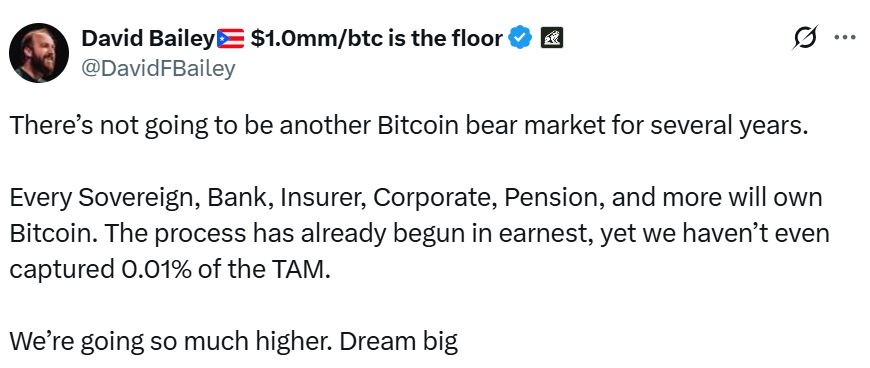
David Bailey, entrepreneur and Bitcoin adviser to US President Donald Trump, has made a bold prediction that another Bitcoin bear market won’t occur for several years. The claim comes amid unprecedented institutional interest in cryptocurrency markets, marking what Bailey describes as the “first time we’ve ever seen real institutional buy in.”
Speaking on X Saturday, Bailey emphasized that “Every Sovereign, Bank, Insurer, Corporate, Pension, and more will own Bitcoin.” He noted that the process has already begun in earnest, yet institutions haven’t captured even 0.01% of the Total Addressable Market (TAM).
Bailey, founder of Bitcoin Magazine and BTC Inc., played a central role in Trump’s Bitcoin pivot during the presidential campaign. Over the past two years, institutional holdings have surged past $100 billion, primarily through exchange-traded funds (ETFs) and crypto treasury strategies.
Market Analysts Present Contrasting Views
Despite Bailey’s optimism, crypto analysts point to several potential headwinds. CK Zheng from ZX Squared Capital told Cointelegraph that crypto remains highly correlated with stock markets, warning that “if it slows into a bear market, crypto will follow.”





However, recent Federal Reserve developments provide some support for bullish sentiment. Zheng noted that Fed Chair Jerome Powell’s recent speech signals likely interest rate cuts beginning in September, potentially starting a low-interest-rate cycle.
Pav Hundal from Australian crypto broker Swyftx acknowledged the current risk-on environment supporting high-momentum assets like Bitcoin and Ether. Nevertheless, he cautioned that “macro shocks come when you least expect them” and expects eventual re-rotation into fixed-income instruments.
Potential Timeline and Risk Factors
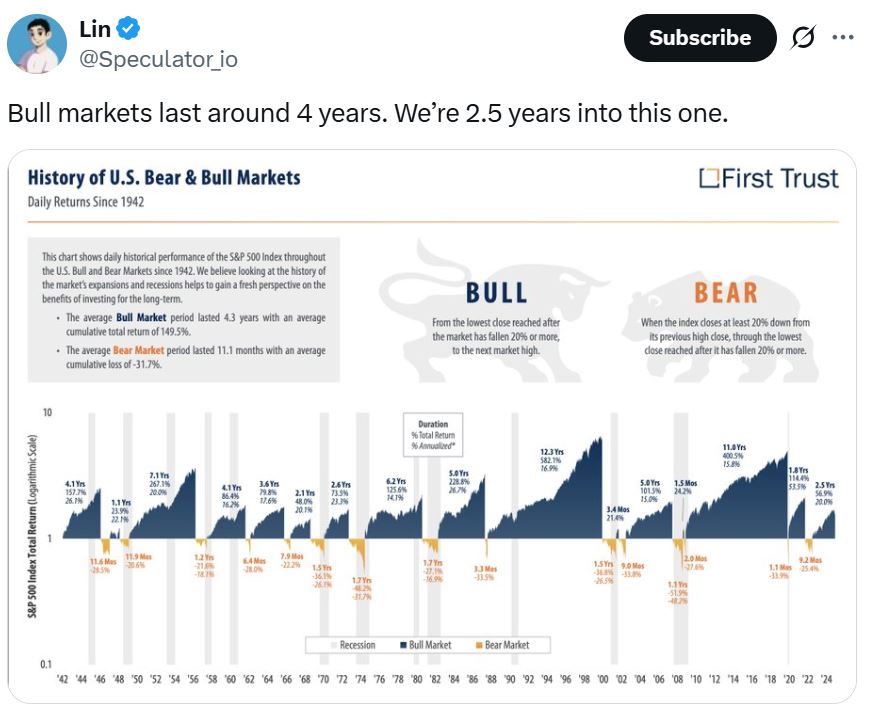
Ryan McMillin from Merkle Tree Capital projects a more specific timeline, suggesting a market top around Q2 2026 followed by a “relatively mild bear market by mid-2026” if global liquidity reverses. He identified leverage unwind from debt-fueled Bitcoin purchases and regulatory shocks as potential catalysts.
However, McMillin acknowledged the possibility of no bear market, drawing parallels to gold’s performance post-ETF launch in the early 2000s, when the asset experienced eight consecutive years of gains after financialization.



























Comments are closed.