
Featured News Headlines
- 1 IOTA: A Revolutionary Cryptocurrency and Tangle Technology for the Internet of Things
- 2 The Limitations of Traditional Blockchain and the Rise of IOTA
- 3 What is the Tangle and How Does It Work?
- 4 Key Use Cases and Potential of IOTA
- 5 Coordicide: The Future of IOTA
- 6 Key Differences Between IOTA and Other Cryptocurrencies
- 7 IOTA Is Building the Future Layer for Data and Value
IOTA: A Revolutionary Cryptocurrency and Tangle Technology for the Internet of Things
In recent years, we’ve heard a lot about cryptocurrencies and blockchain technology, which have brought about revolutionary changes in various fields, from finance to supply chains. While pioneers like Bitcoin and Ethereum paved the way, their technological underpinnings have certain limitations. This is where IOTA (Internet of Things with Tangle) enters the scene, offering a fundamentally different approach from traditional blockchain and focusing specifically on the world of the Internet of Things (IoT). So, what exactly is IOTA, and why is it so important? Let’s take a deep dive into IOTA’s unique architecture, its working principles, and its future potential.
The Limitations of Traditional Blockchain and the Rise of IOTA
Blockchain, as a decentralised and distributed ledger system, securely and transparently stores transaction records. However, this technology presents some fundamental challenges, especially for the IoT ecosystem where billions of devices will be interconnected:
- Scalability Issues: On a blockchain, every transaction is added to a block, and confirming these blocks takes a certain amount of time. As the number of users on the network increases, transaction speed slows down, leading to network congestion. Bitcoin can only handle about 7 transactions per second, which is woefully inadequate for the microsecond data flow of the IoT world.
- Transaction Fees: To get transactions verified on a blockchain, a fee must be paid to miners or validators. These fees are not economically viable for small-value micro-payments. This model is unsustainable for the millions of micro-transactions that will occur between IoT devices.
- Centralisation Tendency: Over time, the mining power on a blockchain can become concentrated in a few large pools due to the high cost of hardware. This can undermine the network’s theoretical decentralised structure.
- Resource Consumption: Bitcoin’s “Proof-of-Work” mechanism consumes a massive amount of energy, leading to significant environmental concerns.
IOTA addresses these issues with a completely new approach. Instead of a blockchain, it uses a Tangle, a data structure based on a Directed Acyclic Graph (DAG). This innovative structure distinguishes IOTA from traditional cryptocurrencies and gives it unique advantages.
What is the Tangle and How Does It Work?
The Tangle is the core of IOTA, a revolutionary data structure that resembles a digital spiderweb. While blocks on a blockchain are linked in a linear fashion, on the Tangle, each new transaction confirms at least two previous, unconfirmed transactions. These confirmations create a “web of nodes” rather than a linear chain.

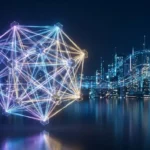



To put it more simply:
- The Confirmation Mechanism: Anyone who wants to make a transaction on IOTA must first confirm at least two old, unconfirmed transactions already on the network before they can add their own. This confirmation process is done through a simple “proof-of-work” task. This is a lightweight mathematical problem-solving process that your computer can perform with minimal resources, designed to prevent spam.
- Accumulation of Confirmations: The more other transactions a single transaction is confirmed by, the more secure it becomes. This process increases the strength and validity of transactions as confirmations accumulate on the Tangle.
- Distributed Validation: Unlike a blockchain, the Tangle has no miners or validators. Every user who participates in the network both submits their own transaction and helps to secure the network. This means the network’s security is provided in a distributed manner, collaboratively by all users.
Thanks to this unique mechanism, the Tangle offers the following advantages over traditional blockchain:
- Zero Transaction Fees: Since there is no need for miners to validate transactions, there are no transaction fees on IOTA. This makes micro-payments and data transfers between IoT devices economically feasible.
- Infinite Scalability: As the number of users and transactions increases, so does the number of confirmed transactions on the Tangle. This doesn’t cause the network to become congested; instead, it increases the transaction speed and security. The Tangle is, in theory, infinitely scalable.
- True Decentralisation: The risk of centralised structures like mining pools is eliminated. The network’s security is ensured equally by the participation of all users.
- Low Resource Consumption: Instead of complex algorithms requiring high energy, like in traditional blockchain mining, IOTA’s confirmation process consumes very little power. This makes IOTA an environmentally friendly technology.
Key Use Cases and Potential of IOTA
IOTA is more than just a cryptocurrency; it operates with the vision of building a machine-to-machine economic network. This vision holds great potential, especially in the following areas:
- Internet of Things (IoT) and Smart Cities: IoT devices like smart home appliances, sensors, and autonomous vehicles can securely exchange data and value with each other at no cost. For example, a smart sensor can sell the data it collects to other devices, an autonomous vehicle can automatically pay highway tolls, or data from a smart meter can be instantly billed—all made possible with IOTA.
- The Data Economy: The Tangle enables a secure and tamper-proof data marketplace between devices. Companies can instantly buy and sell valuable data from sensors. For example, data from an air quality sensor can be automatically sold to a company conducting environmental pollution analysis.
- Supply Chain Management: The journey of products from manufacturing to the end user can be transparently tracked on the Tangle. The risks of fraud and manipulation are minimised, while instant access to information about the origin and status of products is ensured.
- Electric Vehicle Charging Stations: IOTA’s zero transaction fees make it easy for electric vehicles to use charging stations with micro-payments. The vehicle can automatically initiate the energy exchange and complete the payment instantly as it approaches the charging station.
- Global Digital Identity: The Tangle can be used to securely and decentrally store the digital identities of people and devices. This makes it easier to access various services and prevents identity theft.
Coordicide: The Future of IOTA
In its current state, IOTA’s network uses a central node called the “Coordinator” to provide initial security for the Tangle. This node acts as a failsafe mechanism to protect the network against large-scale attacks. However, this goes against IOTA’s ultimate goal of full decentralisation.
Coordicide (the elimination of the Coordinator) is the most crucial part of IOTA’s roadmap. Once this stage is complete, the Coordinator will be completely removed, and the Tangle will become inherently decentralised and fully secure. The Coordicide project involves developing new consensus protocols and network architecture to ensure the network’s permanent security. Once this phase is completed, IOTA will be able to unlock its true potential.
Key Differences Between IOTA and Other Cryptocurrencies
| Feature | IOTA (Tangle) | Blockchain (Bitcoin, Ethereum, etc.) |
| Data Structure | Directed Acyclic Graph (DAG) | Linear Blockchain |
| Scalability | Infinitely scalable. Speed increases as user count grows. | Limited. Network slows down as user count grows. |
| Transaction Fees | Zero. There are no transaction fees. | Present. Mining or validation fees are charged. |
| Consensus | The user submitting a transaction confirms two older transactions. | Miners or validators confirm blocks. |
| Decentralisation | Theoretically fully decentralised (post-Coordicide). | Risk of centralisation due to mining pools. |
| Use Case | Primarily IoT, machine economy, micro-payments. | A broad range (finance, smart contracts, etc.). |
| Energy Consumption | Very low. | High (especially Proof-of-Work models). |
IOTA Is Building the Future Layer for Data and Value
IOTA is not just a cryptocurrency; it offers a fundamental infrastructure layer that will shape the future digital world. The Tangle technology, its radical solution to the scalability and cost issues of traditional blockchain, provides an ideal foundation for the Internet of Things. Unique features like zero transaction fees, infinite scalability, and low energy consumption make IOTA a force for revolution in many fields, from micro-payments to autonomous machine economies, and from smart cities to global supply chains.
While a significant milestone like Coordicide is still awaited, IOTA’s corporate partnerships and technological advancements indicate that this project is poised to play a key role in the future digital economy. The future will be a world where billions of devices are interconnected, and where data and value can flow instantly and securely. And in that world, IOTA, with its Tangle technology, is one of the strongest contenders to be at the centre of it all. To understand IOTA is to understand not just a cryptocurrency, but the technological vision of the future.